North Channel • Ontario

Killarney Bay

2021-2024

Chapter 1

The Mountains I Didn't Know Existed

Discovering Killarney Bay and the La Cloche Mountains was, in many ways, a happy accident.

I knew Killarney was somewhere worth visiting. I knew it was a small town about an hour south of Sudbury, next to a provincial park surrounded by Crown Land. I knew it offered access to the northwestern coast of Georgian Bay, and I knew that this part of the lake was scattered with islands and wilderness.

I also knew the geology would be different.

The Bruce Peninsula, which had already become one of my favourite places to paddle, was dominated by white limestone, shale, and grey dolostone. Killarney was something else entirely — part of the Canadian Shield, where ancient pink granite shaped the shoreline into something far more rugged and primitive.

I knew I wanted to paddle here.

I just didn't know how special it was.

I didn't know about the La Cloche Mountains. I didn't know about the metamorphic rock, the wildlife, or the iconic windswept white pines that somehow manage to grow from bare stone.

I was about to find out.

Chapter 2

The First Glimpse

My first visit was supposed to be about Phillip Edward Island.

Because I was still inexperienced and knew very little about the region, I parked at a public beach, loaded my kayak, and decided to simply follow the shoreline. My thinking was that I could paddle far enough along the coast to eventually reach Phillip Edward Island, cross the remaining stretch of water, and explore from there.

It was not exactly a sophisticated expedition plan.

It was also not particularly successful.

I never reached Phillip Edward Island that day. Instead, I received my first real introduction to the landscape that makes Georgian Bay and Northern Ontario so extraordinary.
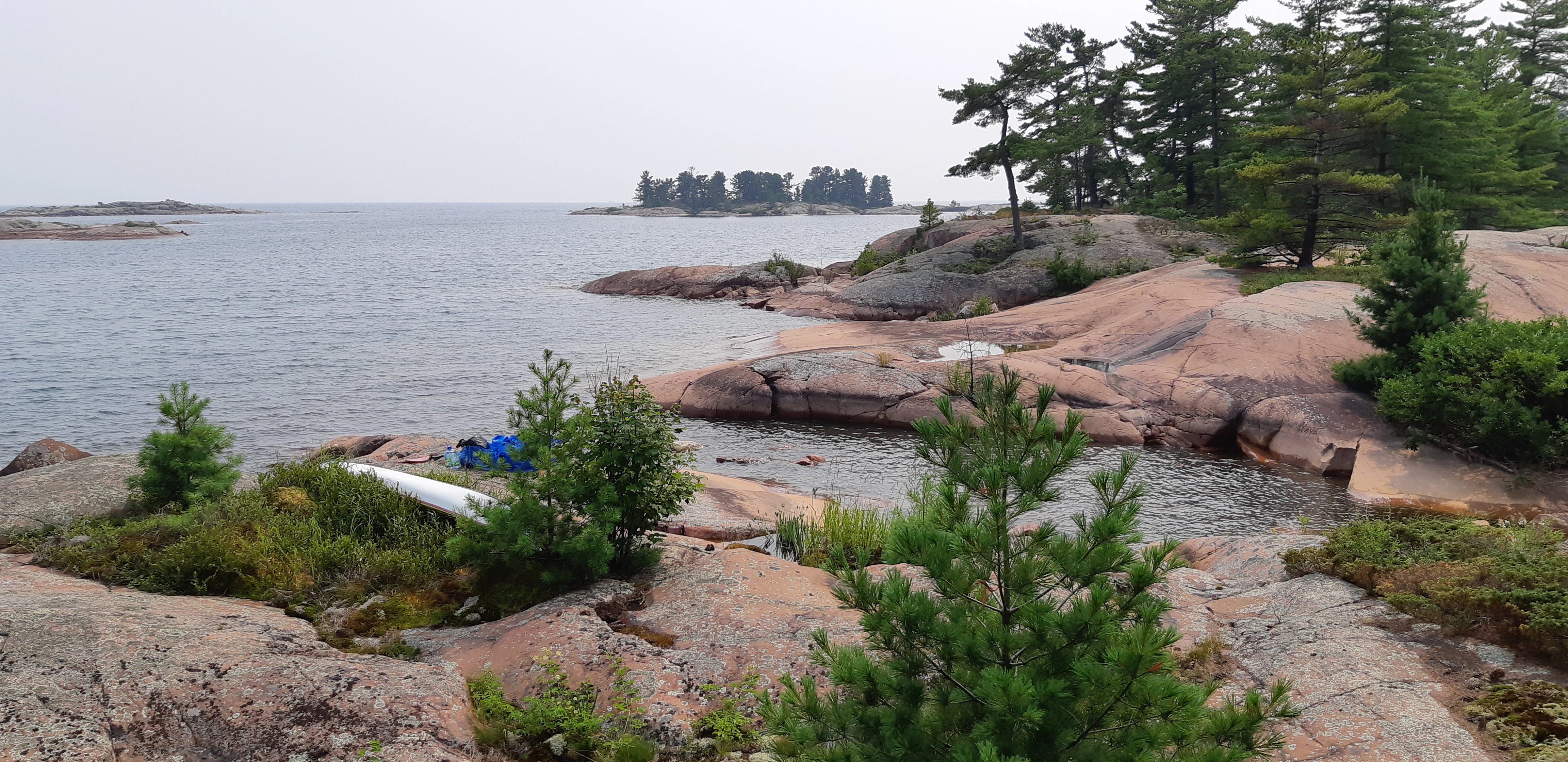
George Island across from Killarney, Ontario, with a sea kayak next to a rock and the La Cloche Mountains far in the distance

Somewhere along the way, I saw something I had never seen before.

Far in the distance, rising above the landscape, was what appeared to be a rocky mountain cliff.

I had hiked through the Laurentians, the Green Mountains of Vermont, the Adirondacks, and other parts of the northeastern wilderness. I had seen plenty of mountains.

This looked different.

From that distance, it barely looked like rock at all.

It looked more like a precious stone — a distant gem catching the light, or perhaps some enormous treasure sitting on the horizon.

I remember staring at it and wanting desperately to get closer.

I wanted to know what I was looking at. I wanted to paddle toward it, get closer, and understand how something that appeared so strange could rise from the landscape so far away.
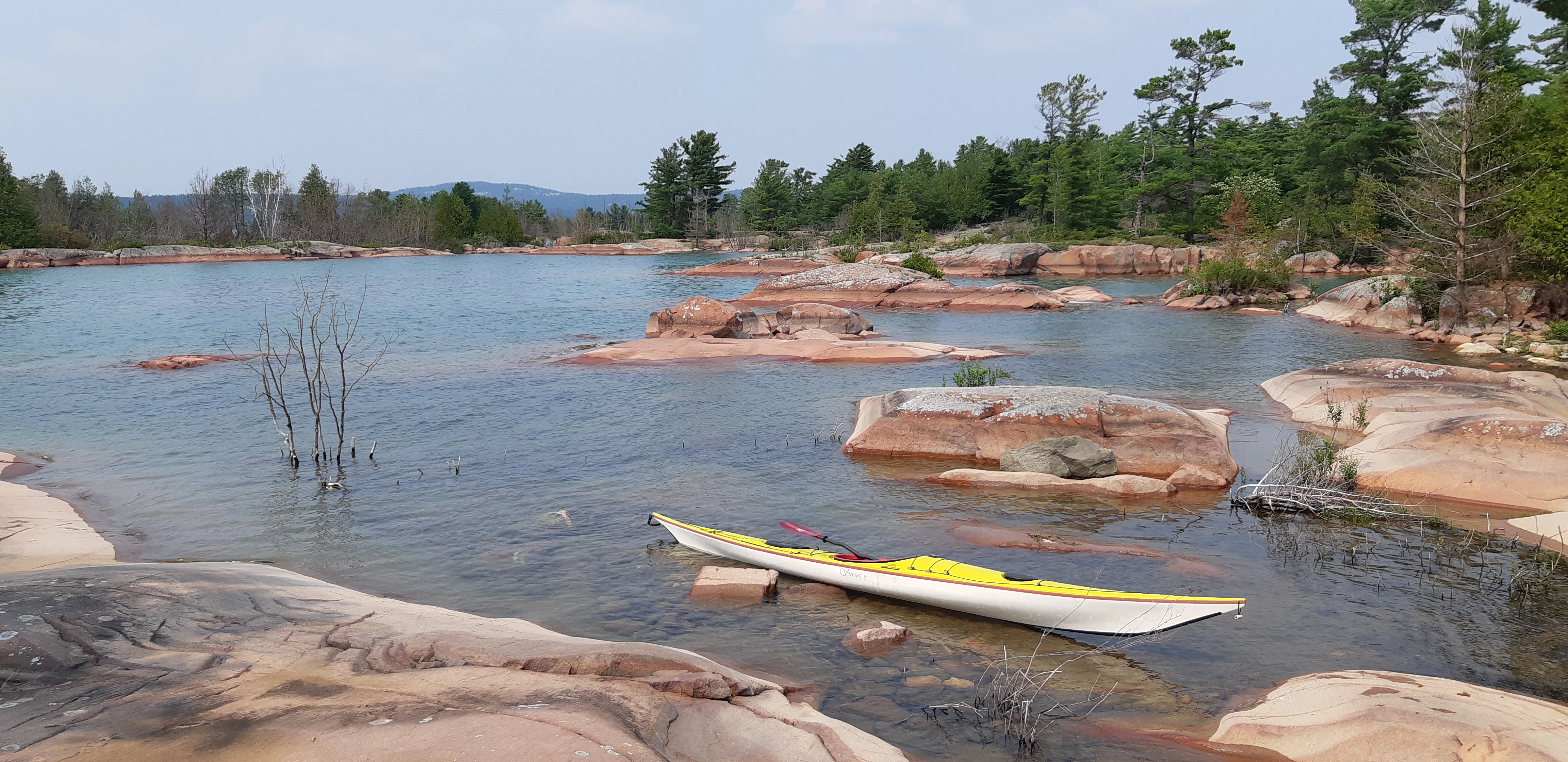
George Island across from Killarney, Ontario, with a sea kayak next to a rock and the La Cloche Mountains far in the distance

But I was already running behind schedule, and I had learned enough by then to know that distances on a map and distances on the water are two very different things. Crossing open water simply because something looks close is exactly the kind of decision that can turn an enjoyable paddle into a very bad day.

My plans were already questionable enough.

The mountain would have to wait.

Perhaps I would see it on another trip.

Perhaps I would come back for it someday.

I didn't yet realize that I had just discovered the beginning of something that would become one of my favourite places to paddle.
Chapter 3

Beyond the Horizon

Eventually, I returned.

This time I planned ahead. I studied maps. I researched the area. And in the meantime, I had hiked portions of the La Cloche Silhouette Trail through Killarney Provincial Park.

There, I finally got my answer.

The strange mountains I had seen shimmering in the distance really were something extraordinary.

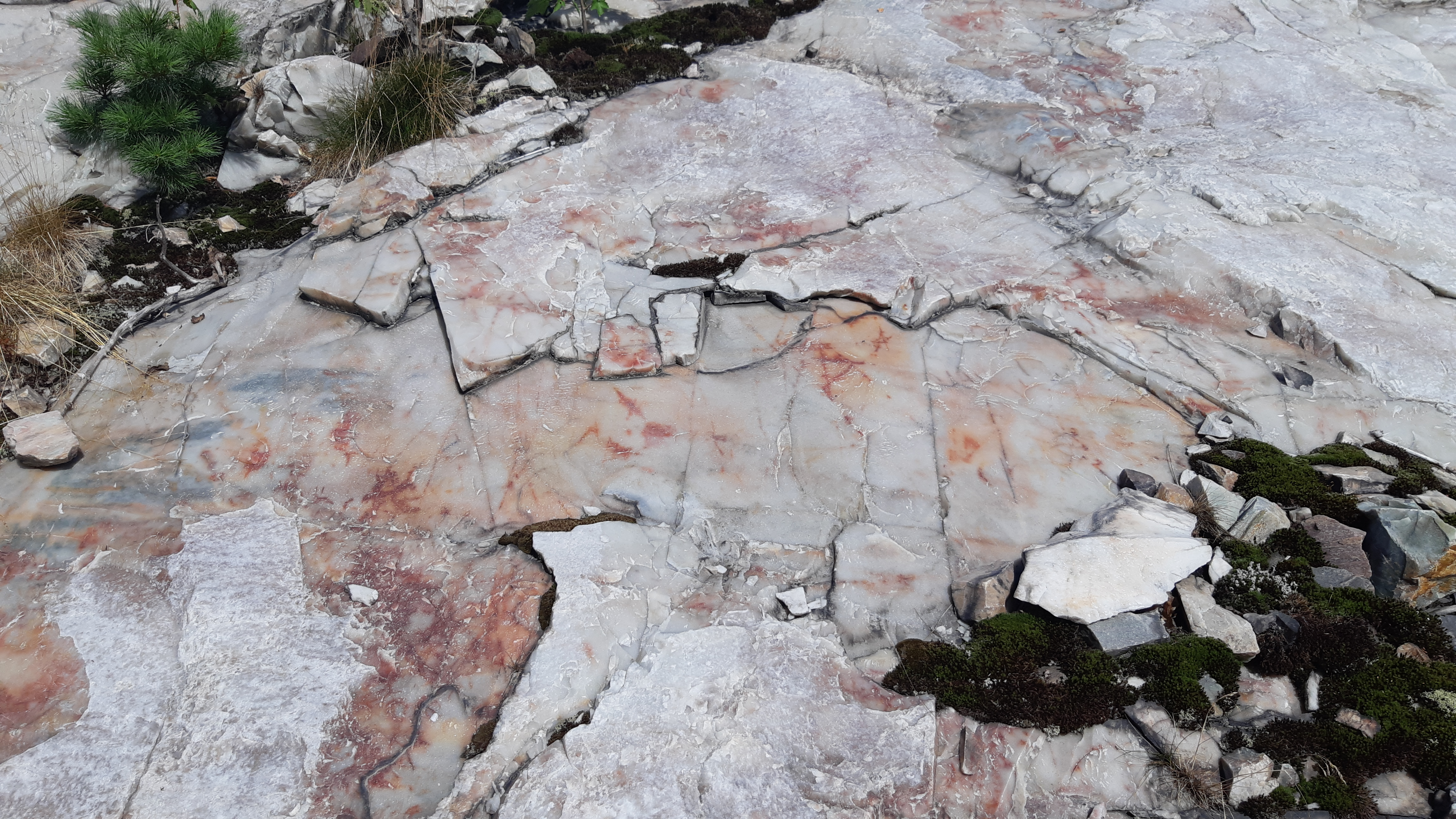
The La Cloche Mountains are largely composed of brilliant white quartzite, and seeing that rock up close was even more remarkable than seeing it from the water.

Walking across it.
Touching it.
Seeing the way it caught the sunlight.

The rock ranged from pearly white to sparkling grey, with veins and subtle shades of pink running through it. Some surfaces were almost porcelain-smooth, while others broke into jagged edges and fractured shapes. Pebbles became boulders. Boulders became cliffs. Cliffs became entire hills.

White, pink and grey, smooth quartzite rocks Killarney, Ontario, photographed on the La Cloche Silhouette trail

The shapes and textures seemed almost unnatural.

As though something had sculpted the landscape deliberately rather than leaving it to geology and time.

I had seen the mountains from the water.

Now I was walking through them.

And even after walking roughly twenty kilometres through the La Cloche Mountains, I still hadn't seen everything they had to offer.

That realization stayed with me.

What had started as a distant curiosity had become something much larger. The mountains were no longer simply a strange shape on the horizon. They were a landscape with its own character, geology, history, colours and textures — something worth returning to again and again.

Chapter 4 Into the Landscape

Eventually, I decided to dedicate an afternoon to exploring the region by kayak.

This time I launched from the same beach as before, but I wasn't wandering blindly toward a destination I barely understood.

I knew that only a few kilometres away were places I had now heard about by name: Portage Cove, Indian Head Cove, Covered Portage Cove, and the surrounding islands and channels.

These were some of the places that had helped put Killarney on the map.

I expected them to be beautiful.

I expected the white quartzite to be impressive.

I expected the landscape to be worth the trip.

What I didn't expect was for the experience to completely reset my expectations of what a day paddle could be.

By this point, I had already experienced places that had seemed almost impossible when I first discovered them. The Bruce Peninsula had introduced me to turquoise water, dramatic limestone cliffs, hidden rock gardens, and landscapes I had never imagined existed in Canada.

Killarney was different.

I had already walked through the La Cloche Mountains.

I had already seen their quartzite.

I thought I understood what was waiting for me along the shoreline.

I was wrong.

I didn't yet know that this would become one of the most spectacular day paddles Lake Huron had given me.

I didn't know that the landscape I had discovered almost by accident would keep revealing new layers every time I returned.

And I certainly didn't know that I was about to spend an afternoon wondering how somewhere so extraordinary had remained almost completely unknown to me for so long.

I was finally about to paddle into it.

The Story Continues

More From Killarney Bay

There is still much more to tell.

That first afternoon in Killarney Bay was only the beginning. The more I returned, the more I realized how much coastline I had yet to see, and how easily one day's adventure could lead to another.

01

Portage Cove

The day paddle that finally brought me into the landscape I had first glimpsed from a distance.

02

Returning to Covered Portage Cove

A second look at a coastline that had already exceeded my expectations.

03

Returning in 2024

Another year, a longer reach, and a different stretch of coastline, including something new I hadn't seen before.

04

Creak Island

Another ambitious attempt to reach Baie Fine, with a route that would take me deeper into the Killarney wilderness.

The stories are still being written.

More coming soon.