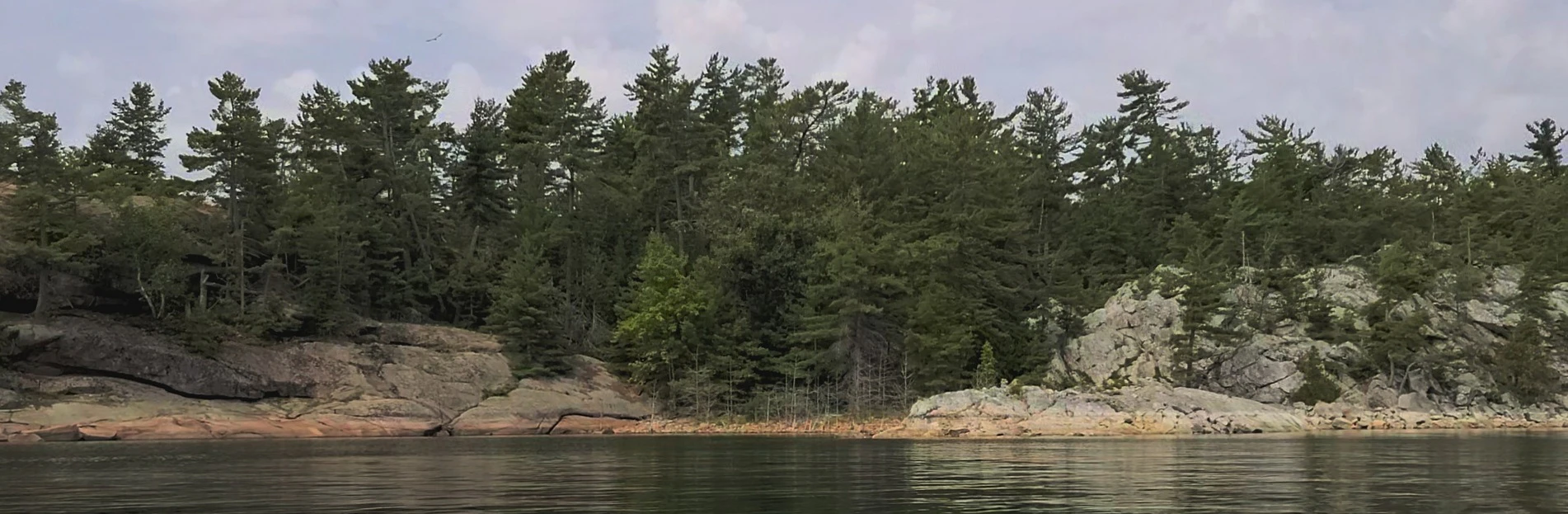
The Benjamin Islands had been quietly sitting in the back of my mind for over a year.
I had heard them mentioned only a few times, but every mention was from someone who know something about special places. Every mention was a hint, that this wasn't just another destination to kayak to, it was a hidden gem.
At the time, I was still cautious about committing to long solo expeditions in unfamiliar waters. Paddling alone always carries a certain amount of risk, but unknown coastlines introduce another layer of uncertainty.
It was knowing whether I'd actually find a safe place to end the day. A suitable campsite needs far more than a flat surface for a tent, or trees to support a hammock. It needs enough shelter if the weather gets bad, trees nearby to hang food safely away from wildlife, and a shoreline where I could unload a fully loaded sea kayak without fighting waves or cliffs.
Most of the expedition happened long before my kayak ever touched the water.
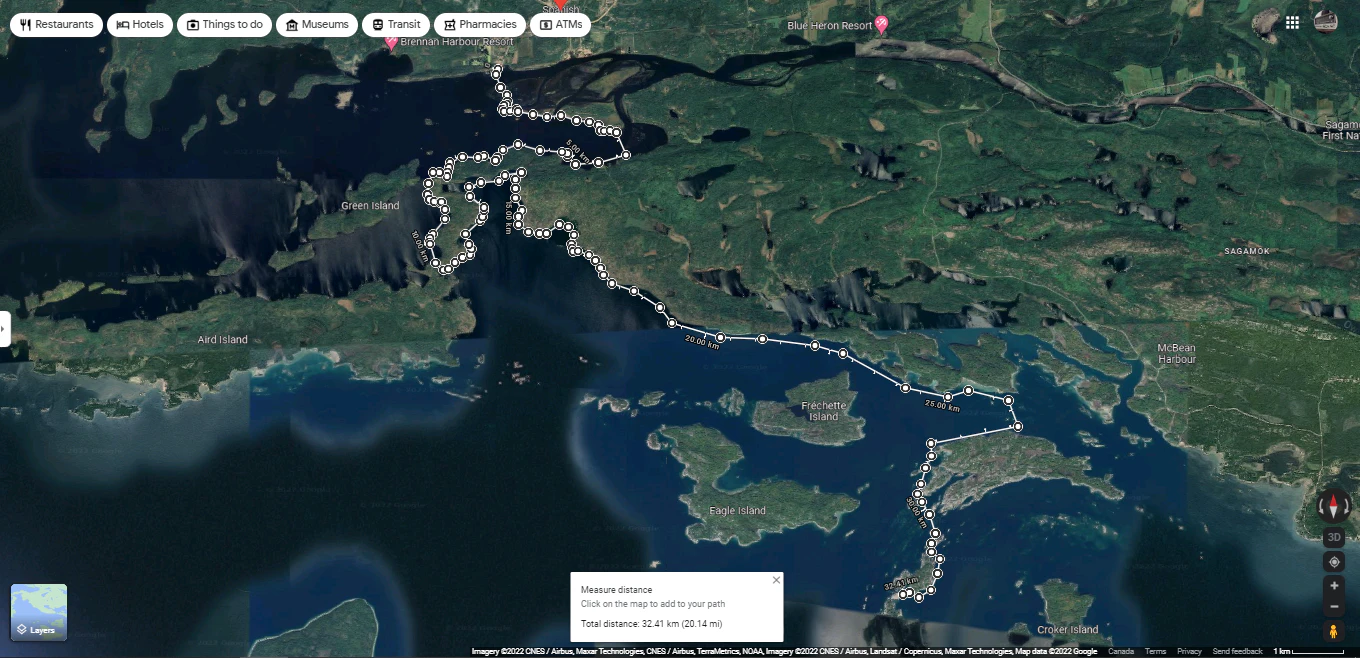
Countless evenings disappeared into Google Maps. I measured crossings, estimated paddling distances, searched for potential campsites, and tried to imagine how exposed each section of coastline would become if the weather changed.
Surprisingly little had been written about paddling the Benjamin Islands, making every decision feel like an educated guess. Looking at their location on the map, I assumed the islands would simply be more of the same. Smooth pink granite but fewer islands. Beautiful, certainly, but nothing radically different from what I had already experienced in the Georgian Bay.
I couldn't have been more wrong.
The trip became impossible to ignore after coming across a well hidden YouTube video
The North Channel was described as one of Ontario's undiscovered paddling locations. David, a kayak guide, mentions how many people visit the Eastern Georgian Bay, due to it's proximity to Toronto. But the landscape gets more remote and scenic as you continue North.
“People tend to stop at Killarney, but keep going. It's worth the extra hour drive”
Still reluctant to commit to this journey with only weeks leading up to my vacation, another unexpected source of inspiration appeared. Nancy Yanaky, whose Group of Seven style paintings I had admired in Killarney, shared one inspired by the Benjamin Islands.
That was the moment the trip stopped being an idea, and crystalized into a plan.
August 6, 2023
I left Montreal and made the long drive west toward Spanish, Ontario. That evening I checked into a small motel nearby, hoping for an early start.
Like many of the trips I make to Northern Ontario, it didn't take long for me to make a new friend. He introduced himself as
When I mentioned that I was planning to paddle to the Benjamin Islands the next morning, his face immediately lit up. He told me he had visited the islands years earlier and remembered them vividly. His description wasn't about beaches or campsites or sunsets. Instead, he smiled and simply said:
"There's some highly metamorphosed rock there."
At the time, I wasn't entirely sure what he meant. I was about to find out.
The rain finally eased just before noon. After months of planning, studying satellite imagery and wondering what waited beyond the Spanish River, it was finally time to launch.
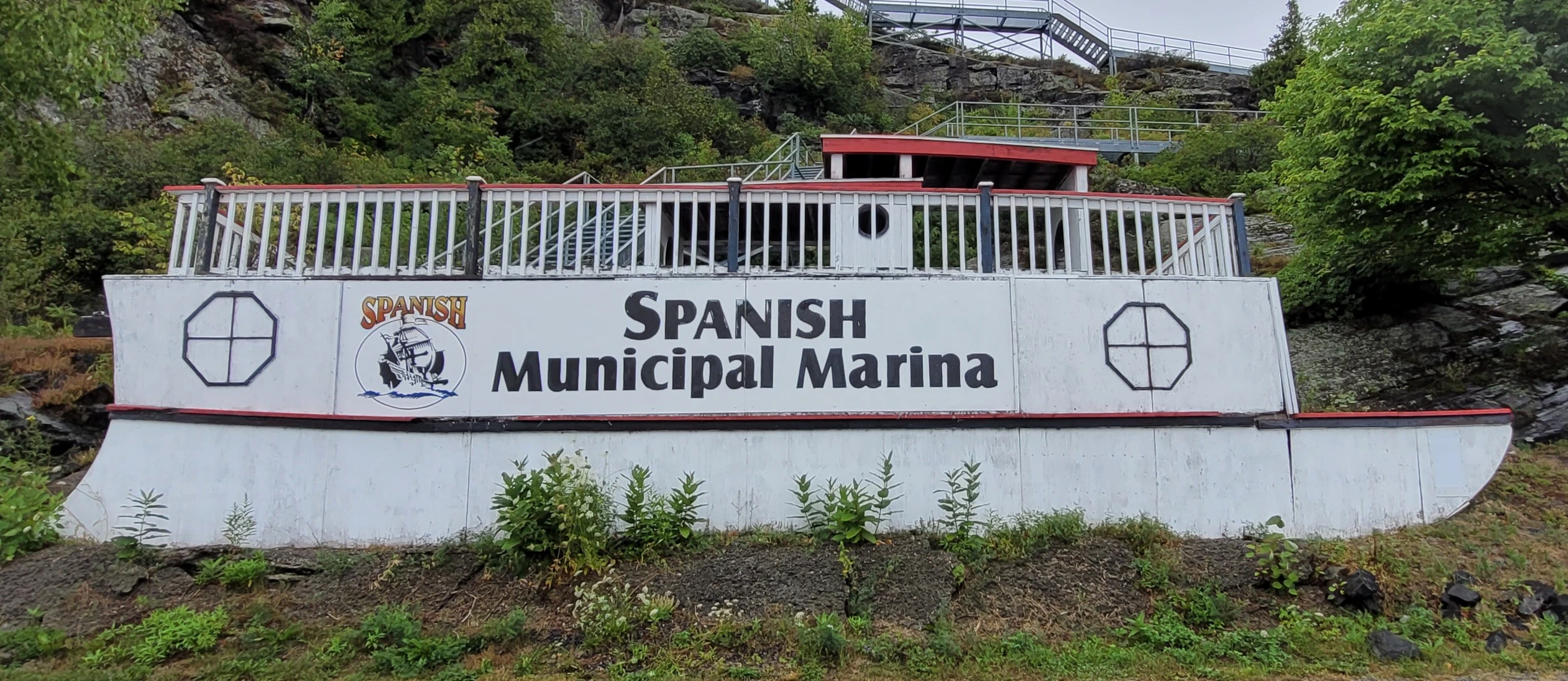
The dockmaster at the Spanish Marina pointed me toward the Benjamin Islands with only a few brief instructions. I packed the last of my gear, pushed away from the dock, and began the long paddle east. Within minutes the marina disappeared behind me. For the first time that day, I was truly alone.
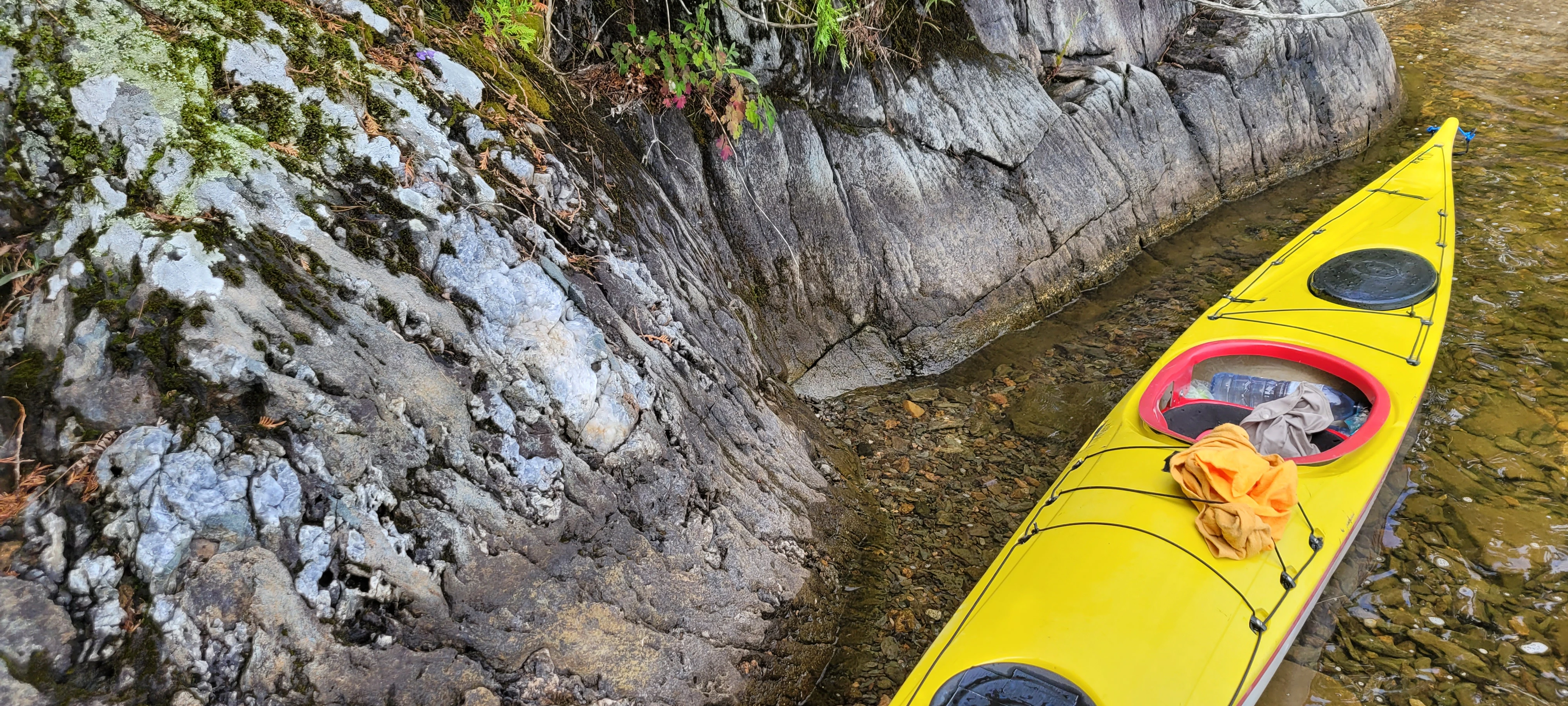
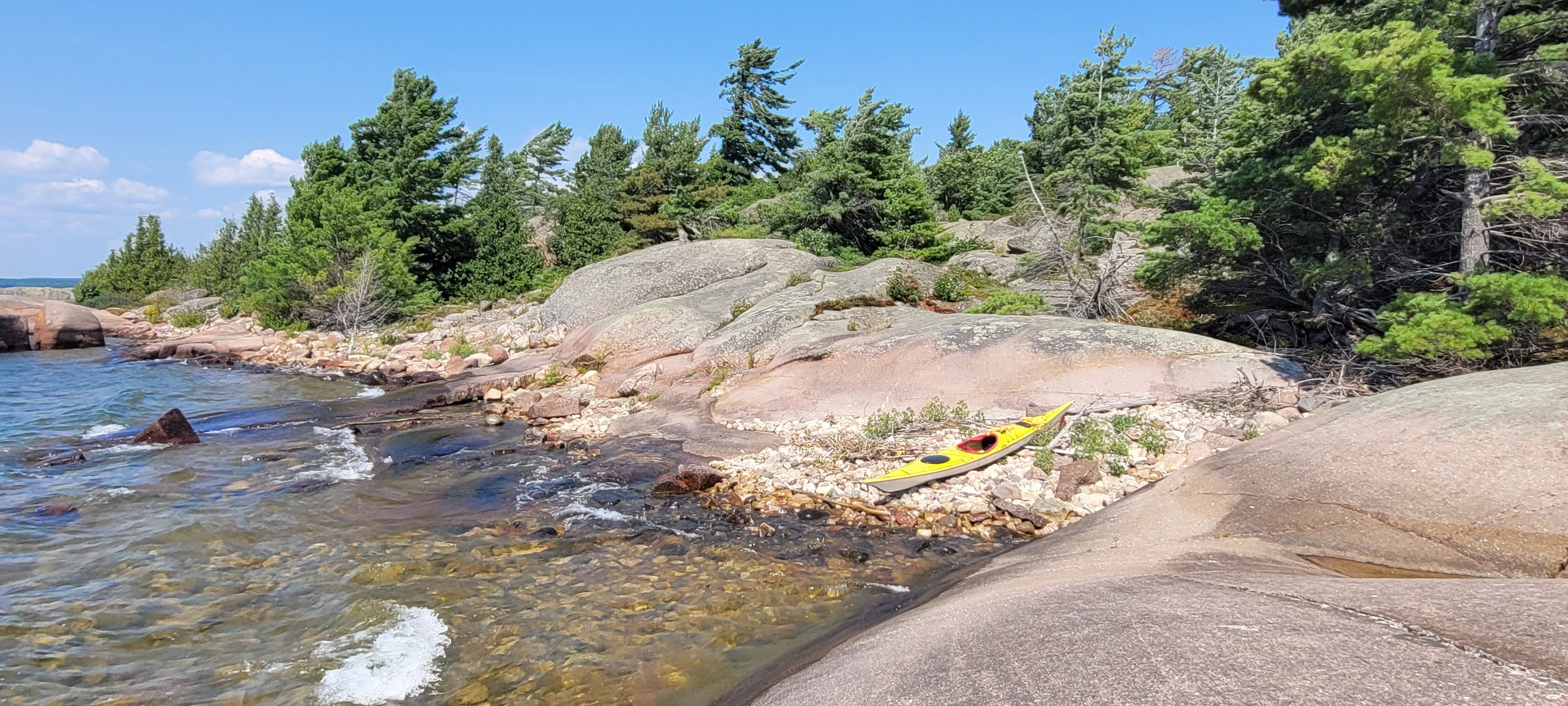
The shoreline was rugged. It offered no exit points for a paddler that frequently hears nature's call. My first break came at Little Detroit Cut, a small passage that connects the Spanish River to the North Channel. A sheltered nook in ankle high water allowed me to get out of my kayak. The quartz running through the surrounding rock hinted that this landscape was already beginning to change.
Leaving Little Detroit Cut felt like crossing an invisible boundary. The dark, river suddenly transformed into something entirely different. The water changed colour. The swell became confused. For twenty or thirty metres the kayak rode through a strange, rolling turbulence before emerging into the North Channel. Ahead lay Dreamer's Bay. Beyond that... The Benjamin Islands.
"Everything beyond this point was completely unknown."
Crossing Dreamer's Bay was only the beginning. Once I reached the northern shoreline, the route became a long, uninterrupted grind eastward. The west wind met me head-on, turning what looked like calm water into hours of steady resistance. There was no dramatic surf or dangerous conditions—just the constant effort of pushing a heavily loaded kayak against the wind. It was physically demanding in a way that doesn't always show in photographs.
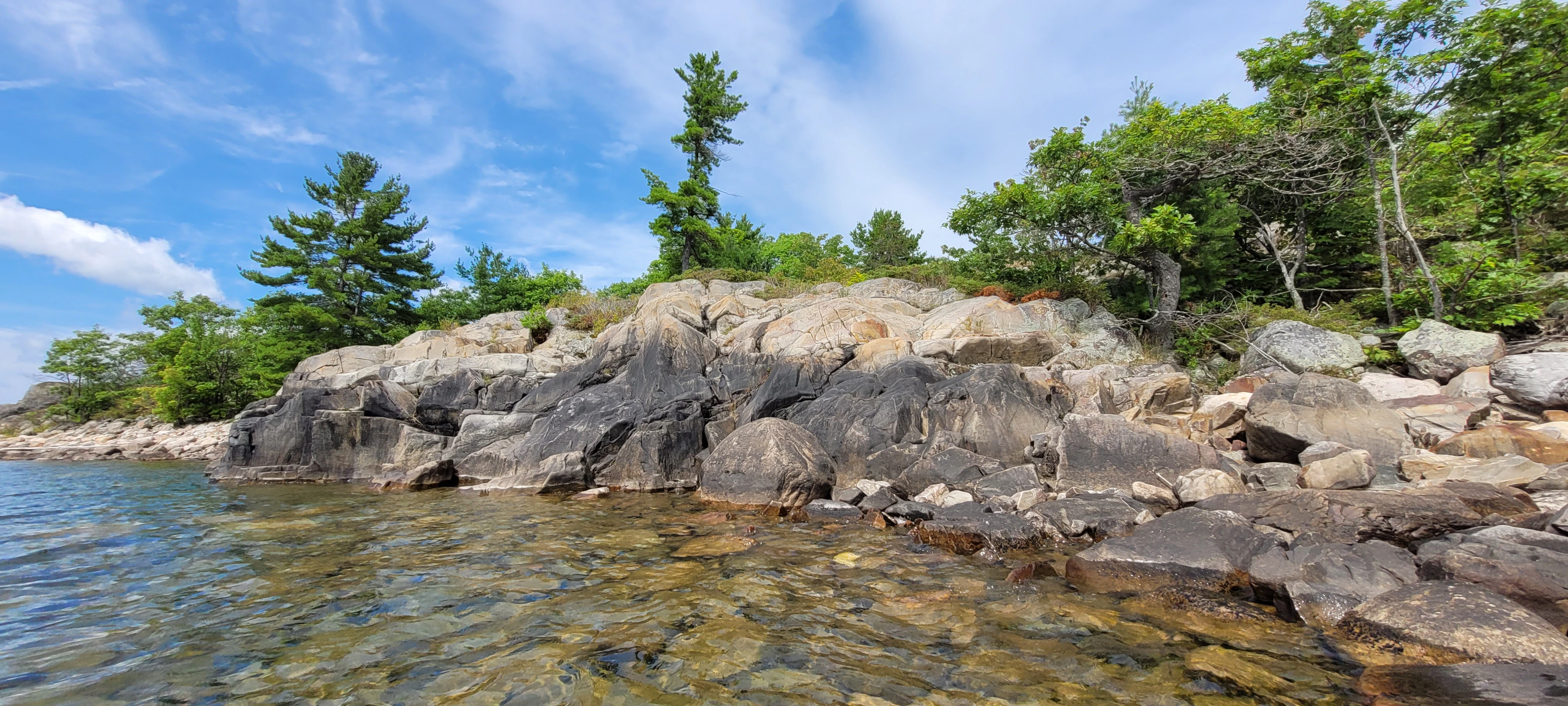
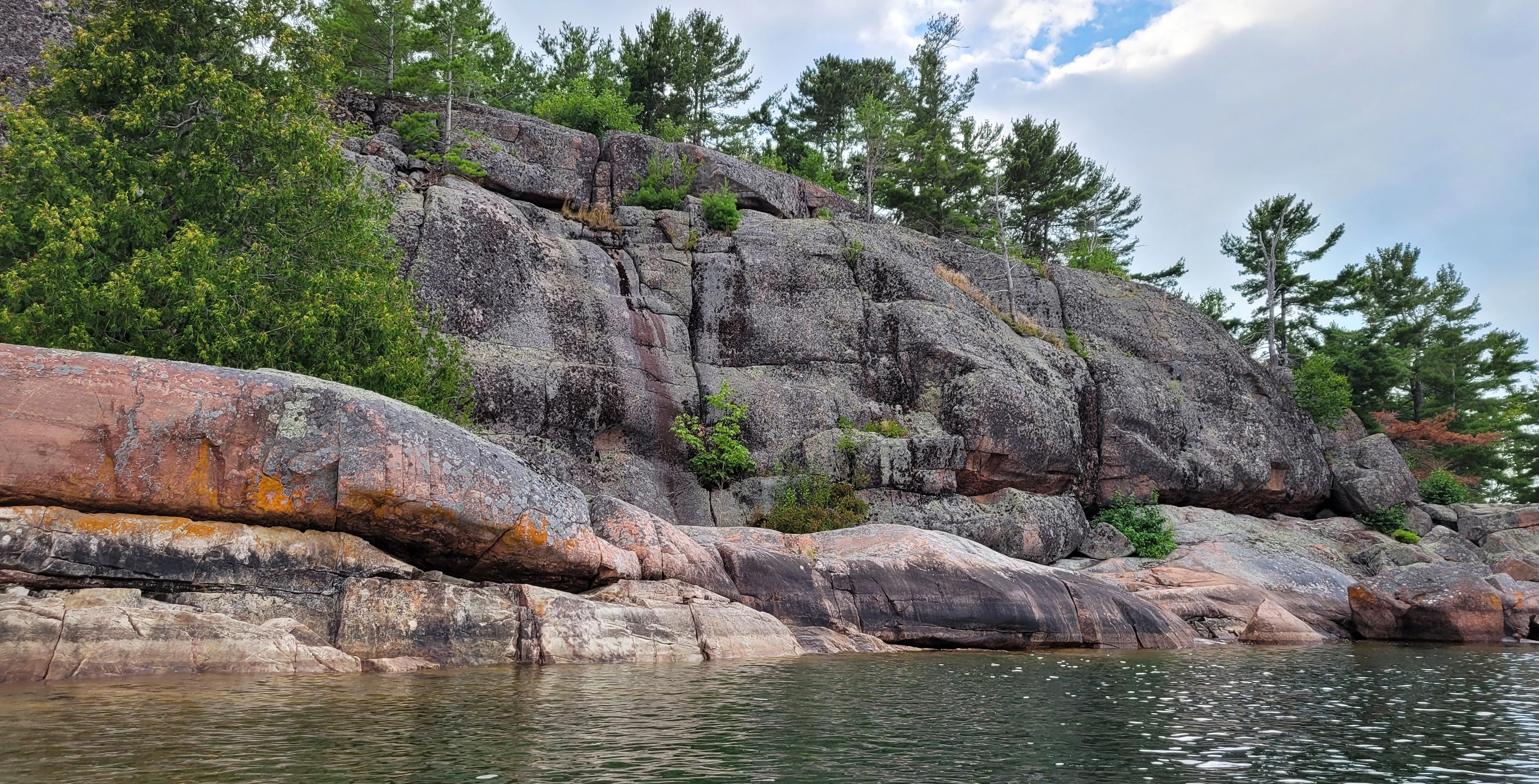
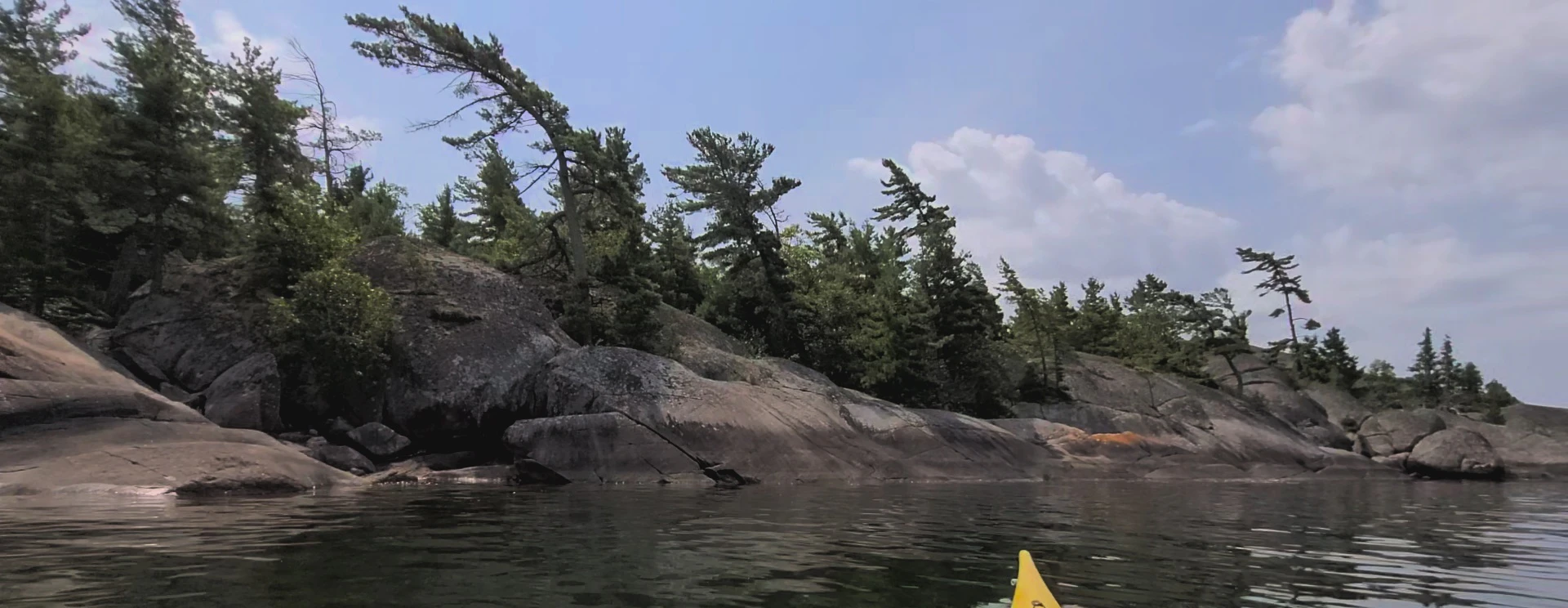
The scenery surprised me. I had expected the familiar smooth pink granite of Georgian Bay. Instead, the shoreline felt older and wilder. Dark cliffs rose directly from the water, fractured rock replaced rounded granite domes, and landing opportunities became surprisingly scarce. Every kilometre reinforced the feeling that I was entering a completely different landscape. Despite not seeing another person for hours, it somehow felt less isolated than the outer islands around Killarney. The North Channel had its own personality—larger, rougher, and somehow more alive.
Sometimes the hardest part of a journey isn't rough water. It's simply never being able to stop.
Somewhere along that shoreline, while carrying a surprising amount of speed, a mink suddenly surfaced barely two feet in front of my bow. For a split second I was convinced I was about to run it over. Before I had time to react, it disappeared beneath the surface just as quickly as it had appeared. It was over almost instantly. Just another reminder that I wasn't travelling through the wilderness. I was travelling within it.
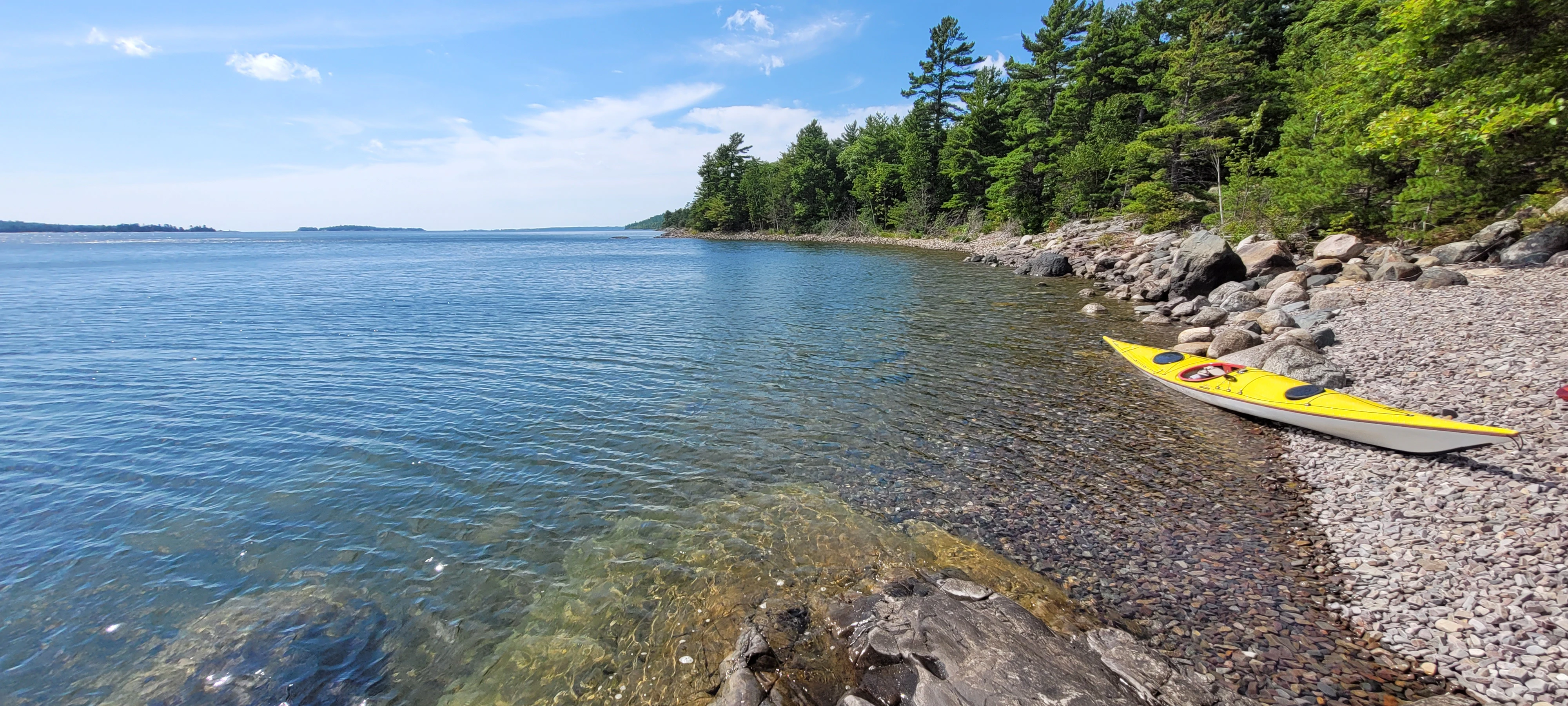
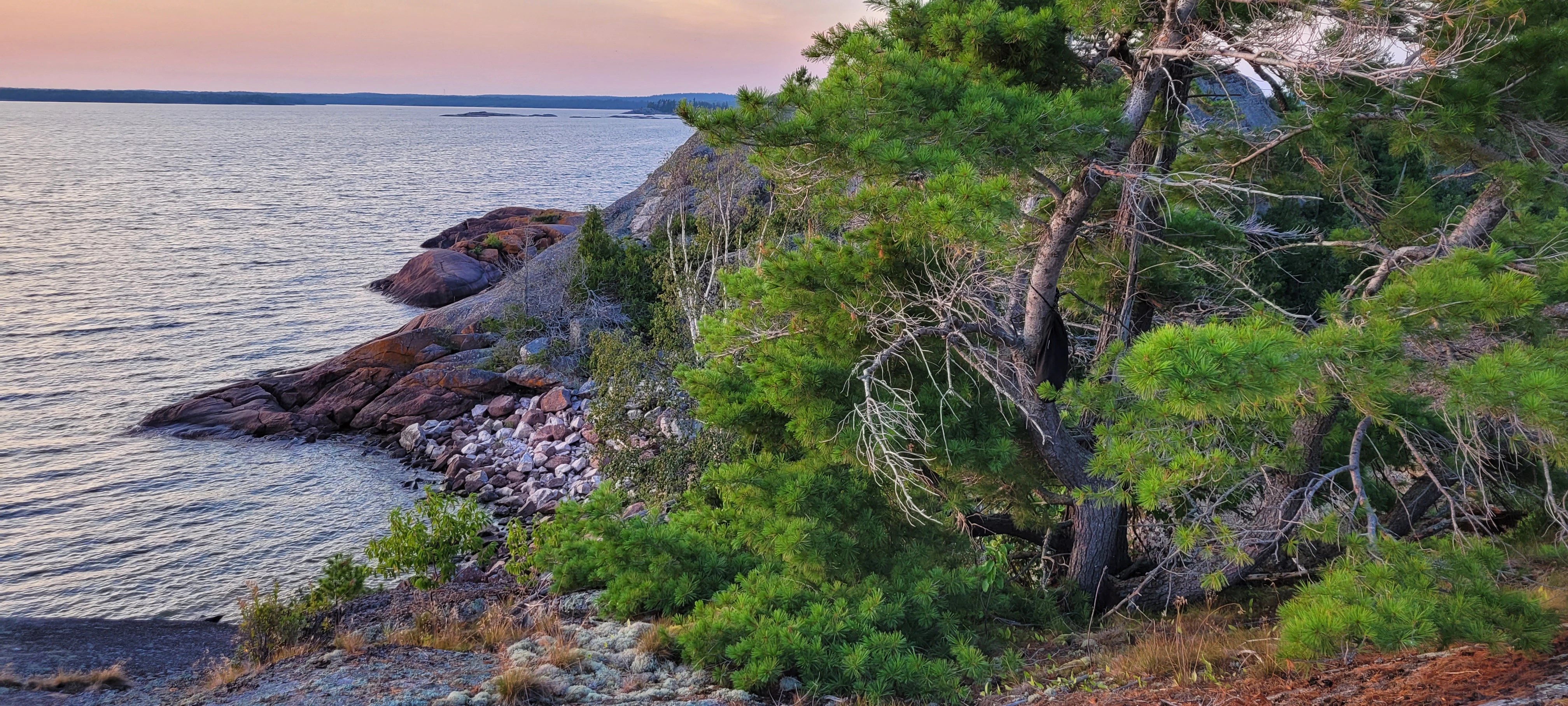
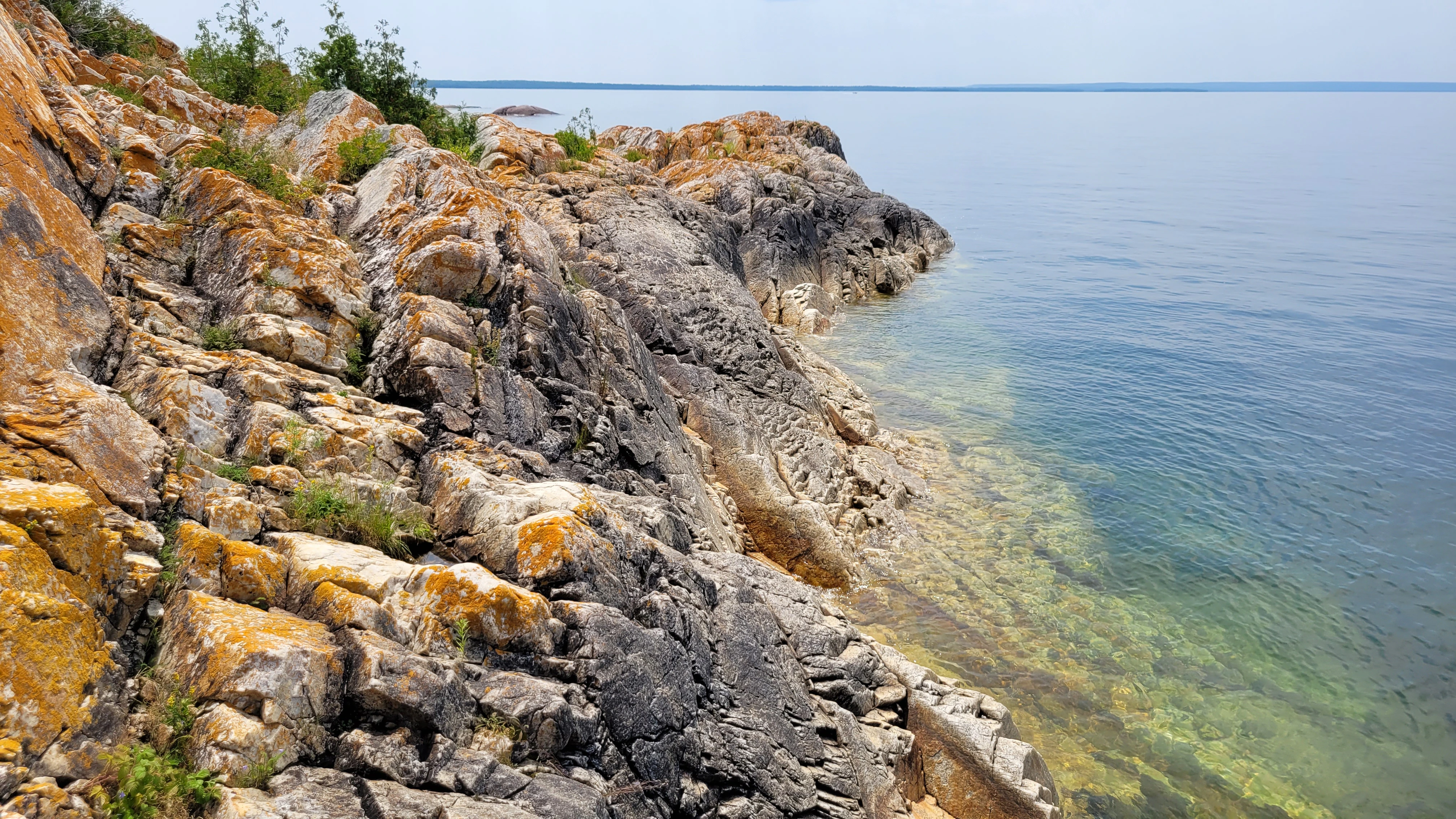
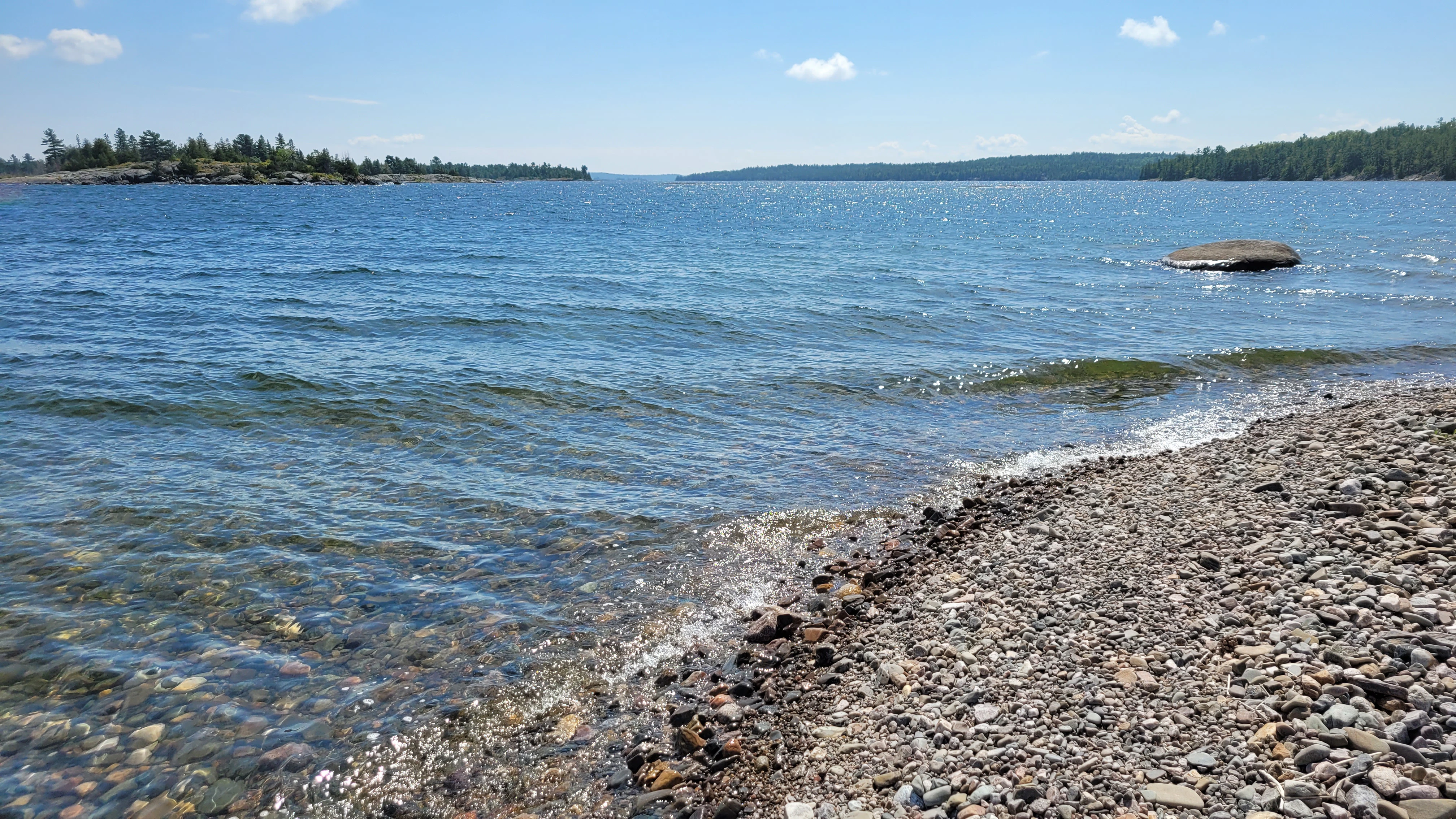
Eventually, the shoreline relented. A small cobblestone beach appeared between the cliffs—nothing spectacular, but after hours of continuous paddling it felt like an oasis. I stepped ashore, stretched aching shoulders, grabbed a quick snack, and studied the map. The water was impossibly clear. Dark volcanic-looking rock surrounded the beach, interrupted by brilliant veins of quartz that hinted at the remarkable geology still waiting ahead. At the time, I thought I was starting to understand the landscape that this area had to offer. I had no idea what was waiting for me at the Benjamin Islands just beyond the next crossing.
The crossing to Fox Island was surprisingly uneventful. After the effort of the previous kilometres, and the proximity of my destination, the island felt welcoming. As I rounded the western shoreline, that feeling disappeared almost immediately.
The wind wrapped around the point, piling waves and swell that bounced unpredictably off the rocky shoreline. As I passed the entrance to Fox Harbour, I instinctively slowed.
It looked absolutely beautiful.
Sheltered from the wind, its calm water contrasted sharply with the restless North Channel outside. The dramatically different landscape showcasing a labyrinth of smooth rocks and channles invited me to explore everything that it had to offer.
For a brief moment I seriously considered stopping there for the night.
I knew I had entered somewhere completely different.
Under different circumstances, I probably would have. But daylight was disappearing faster than I wanted to admit, and I still had no guarantee the Benjamin Islands would offer a safe place to land, let alone camp. Curiosity would have to wait. I kept paddling. The farther I moved away from Fox Island, the more isolated everything became. The safety of the harbor disappeared behind me as the conditions grew more violent.
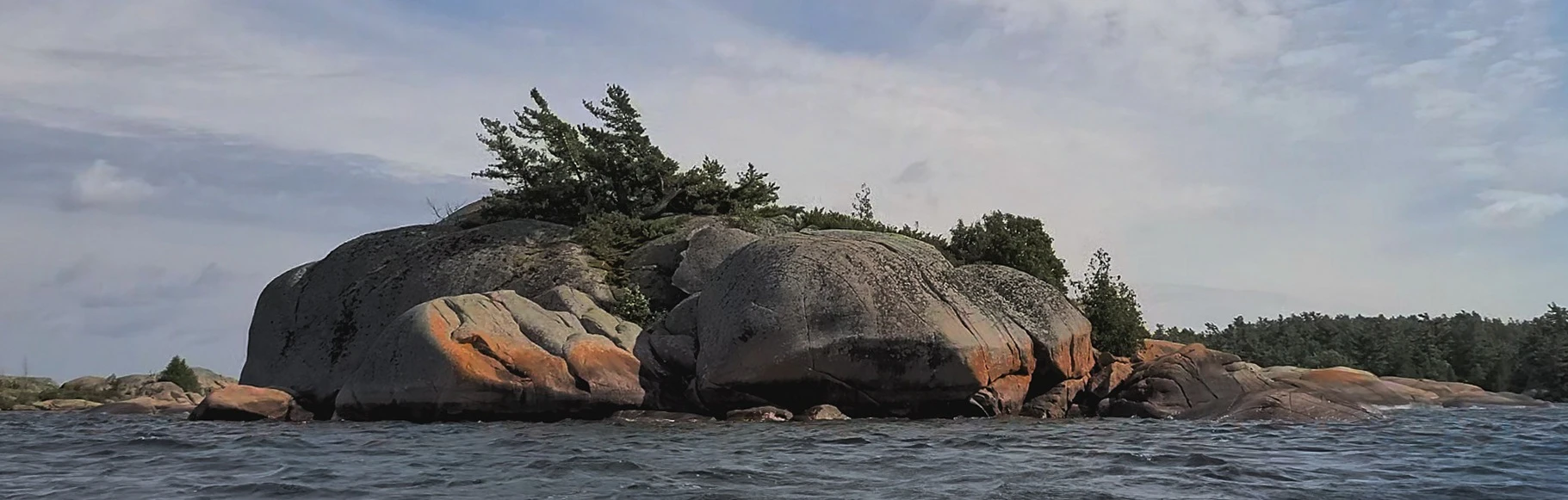
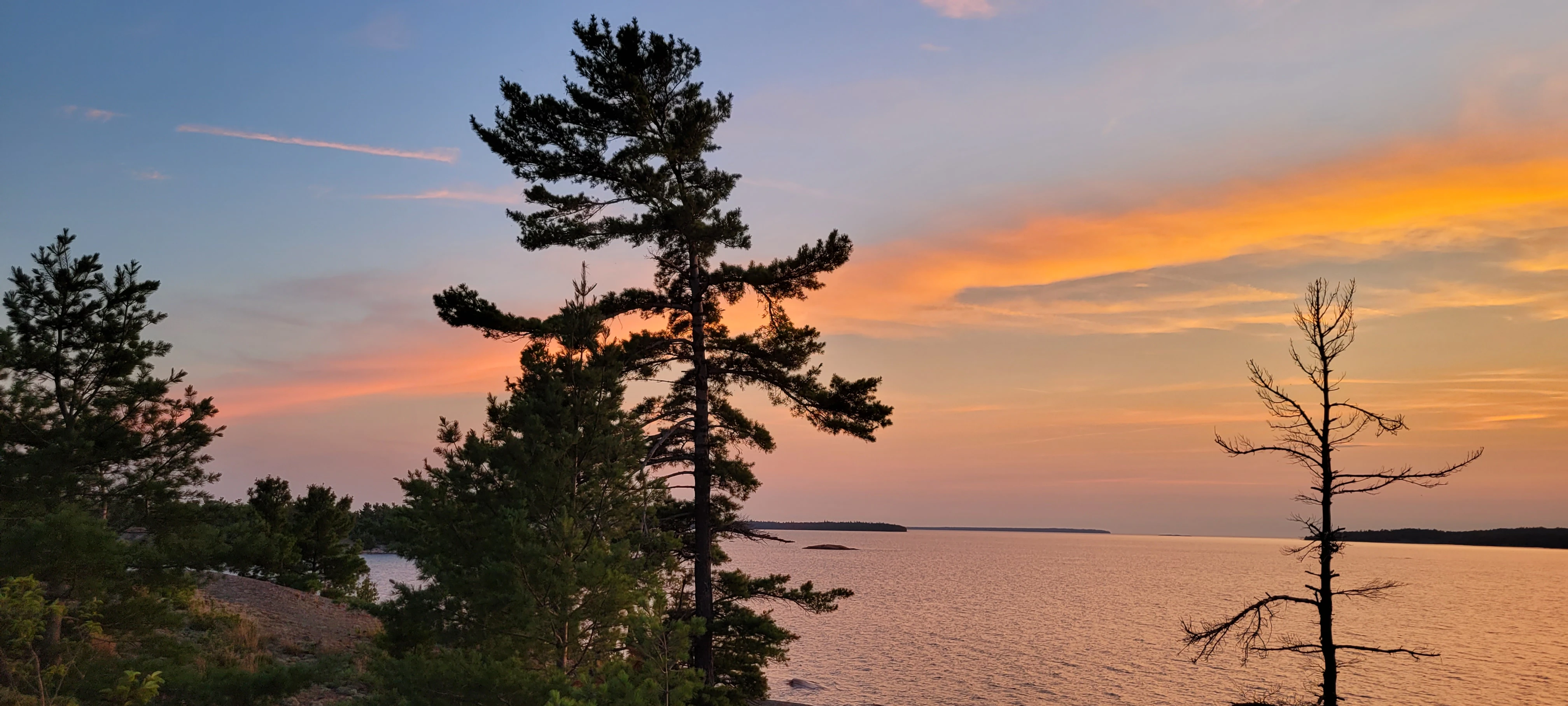
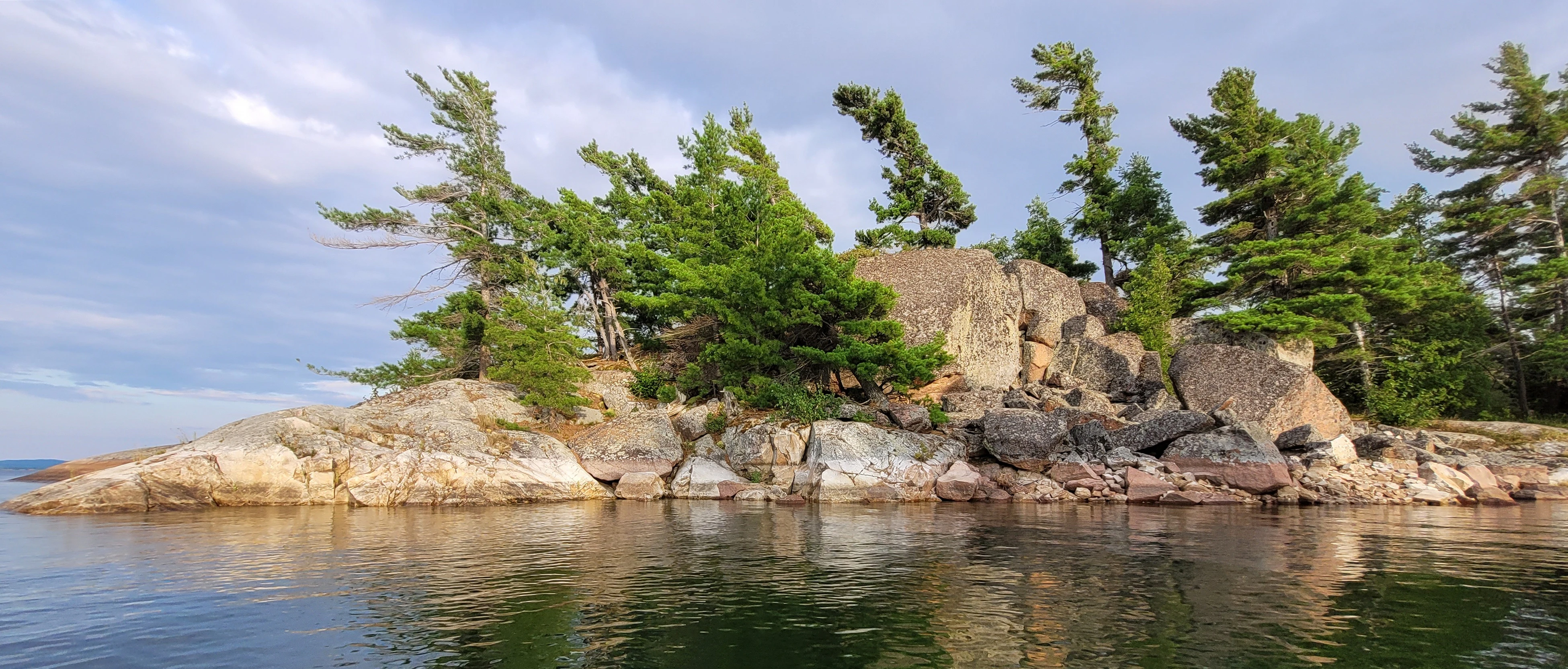
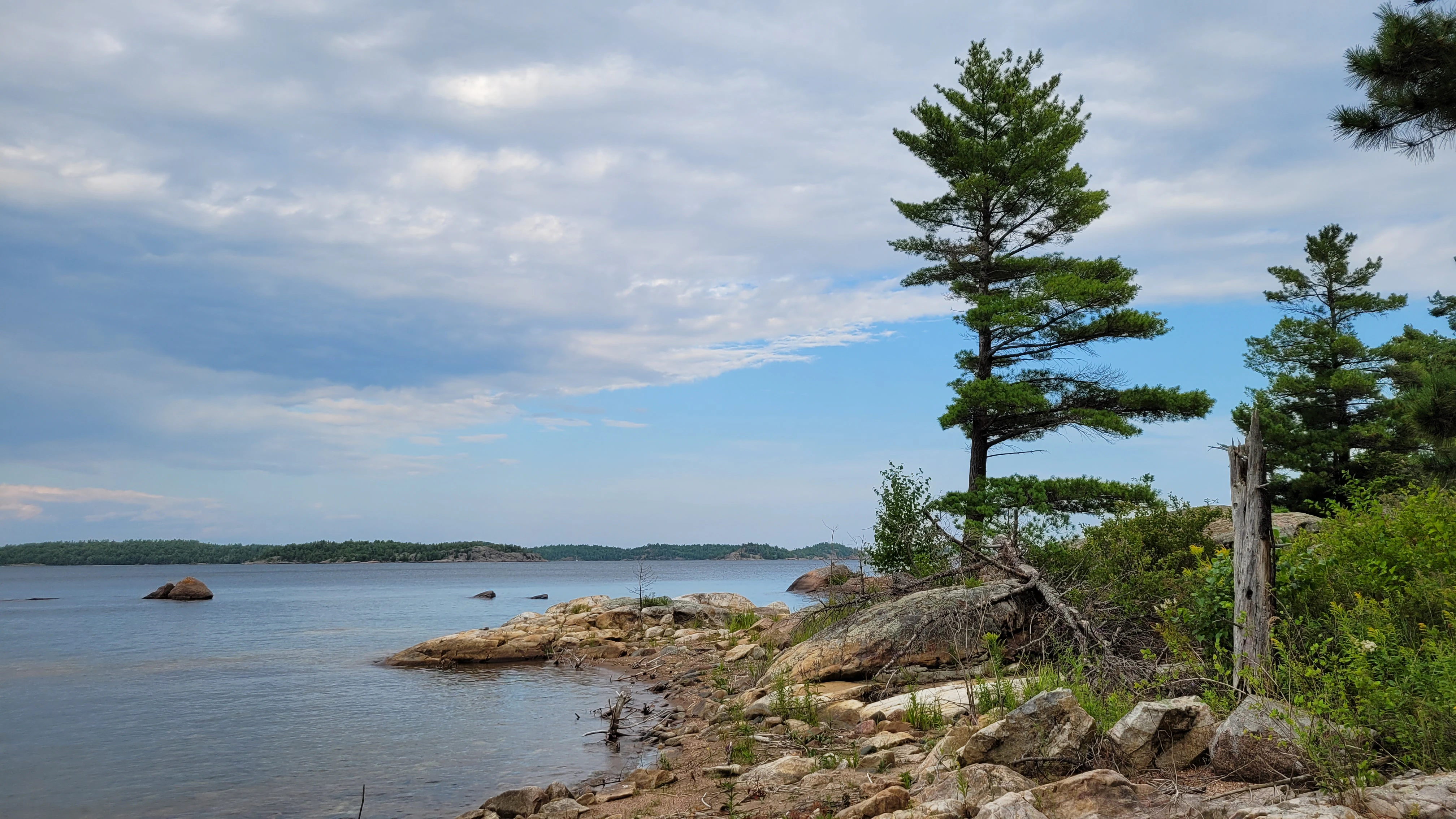
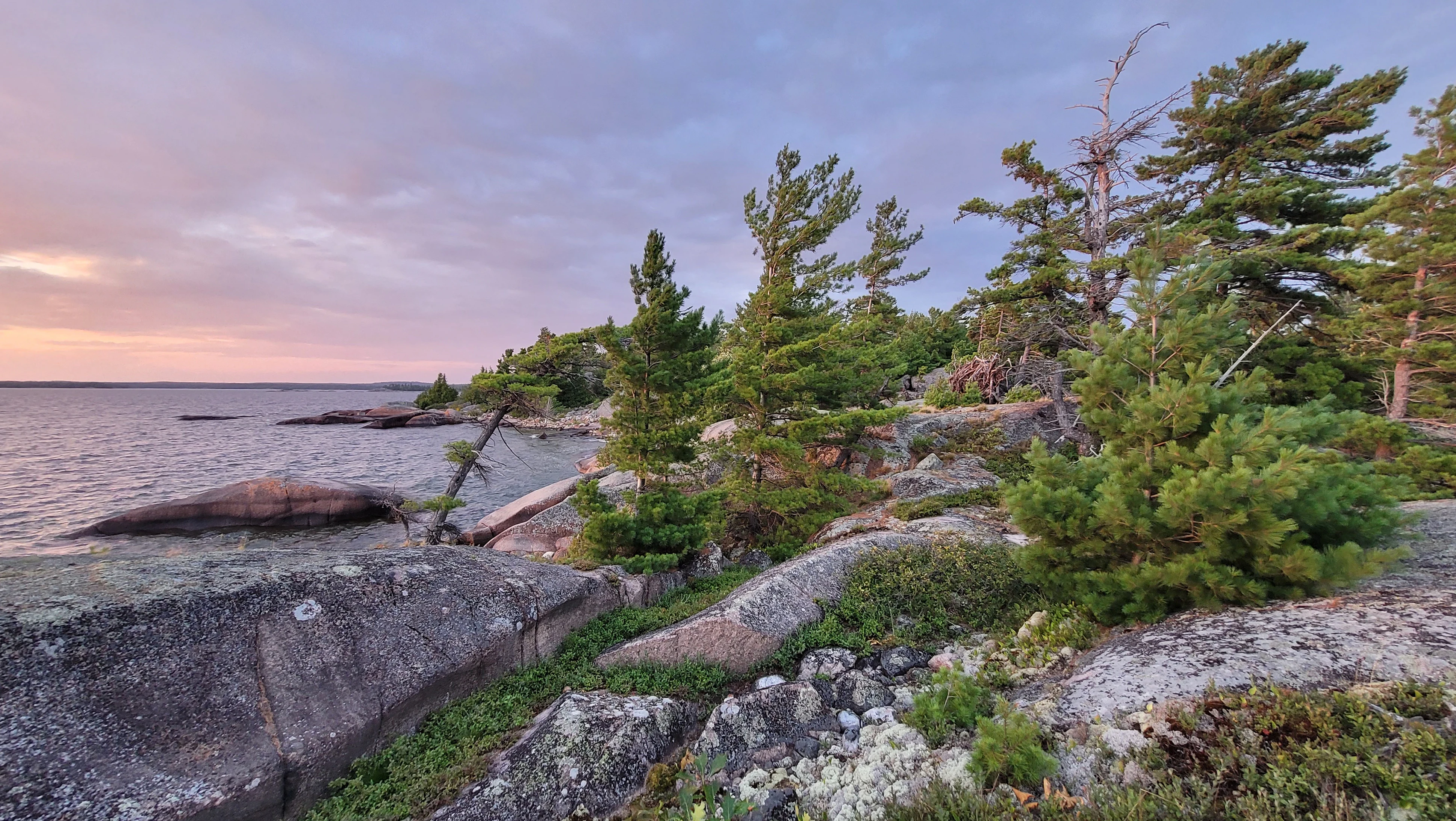
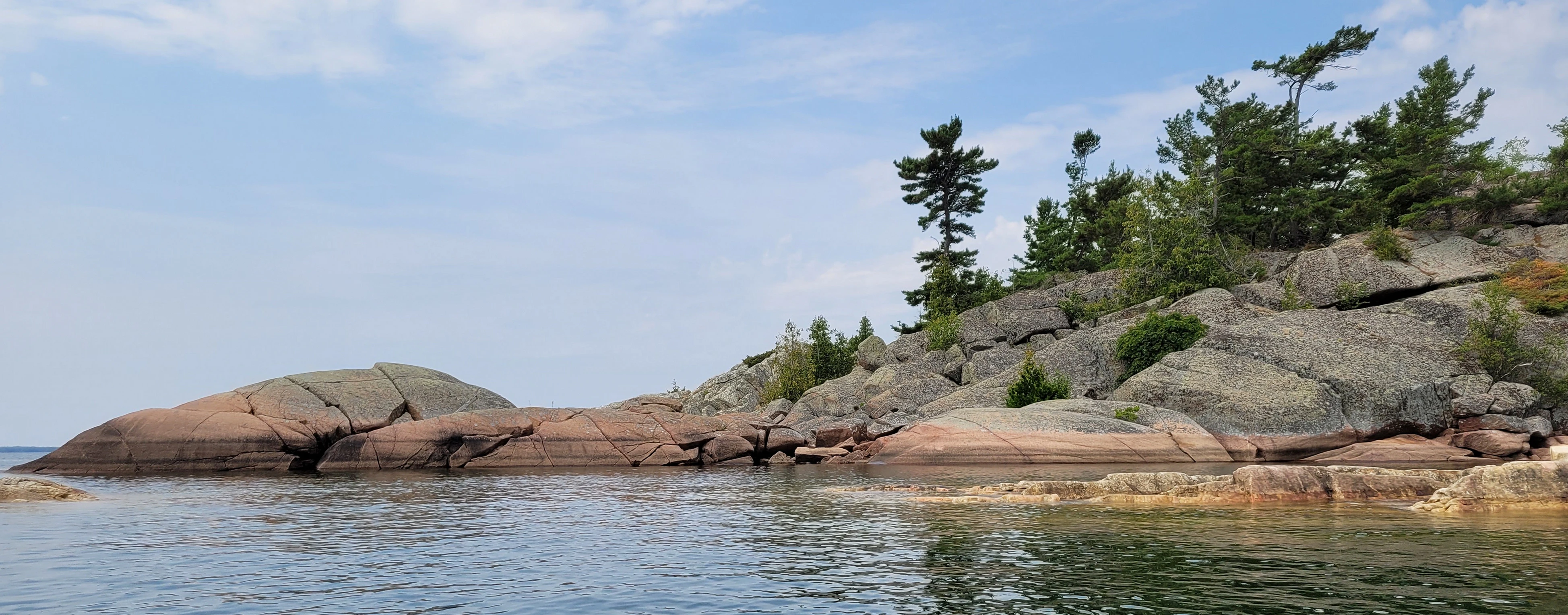
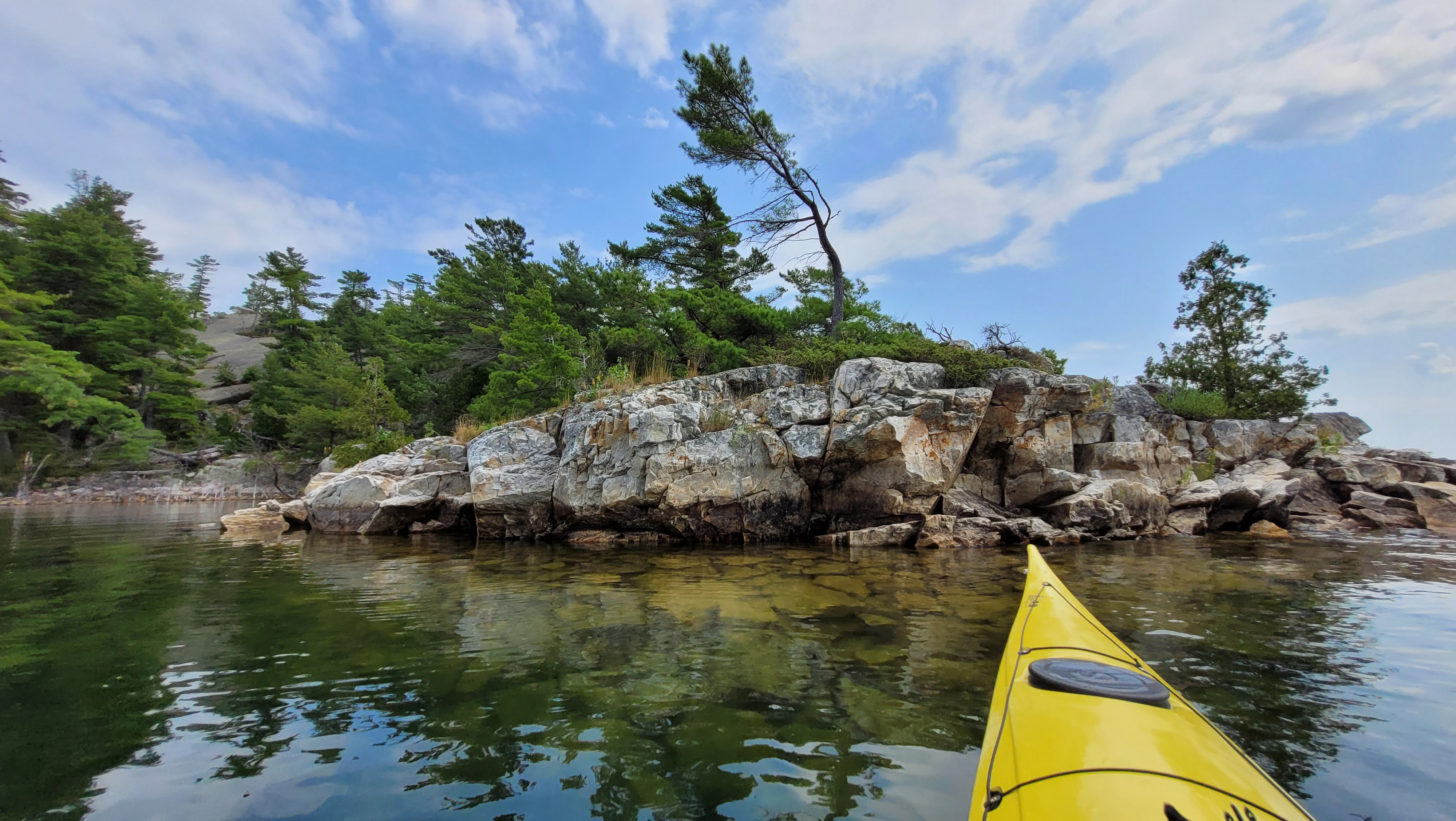
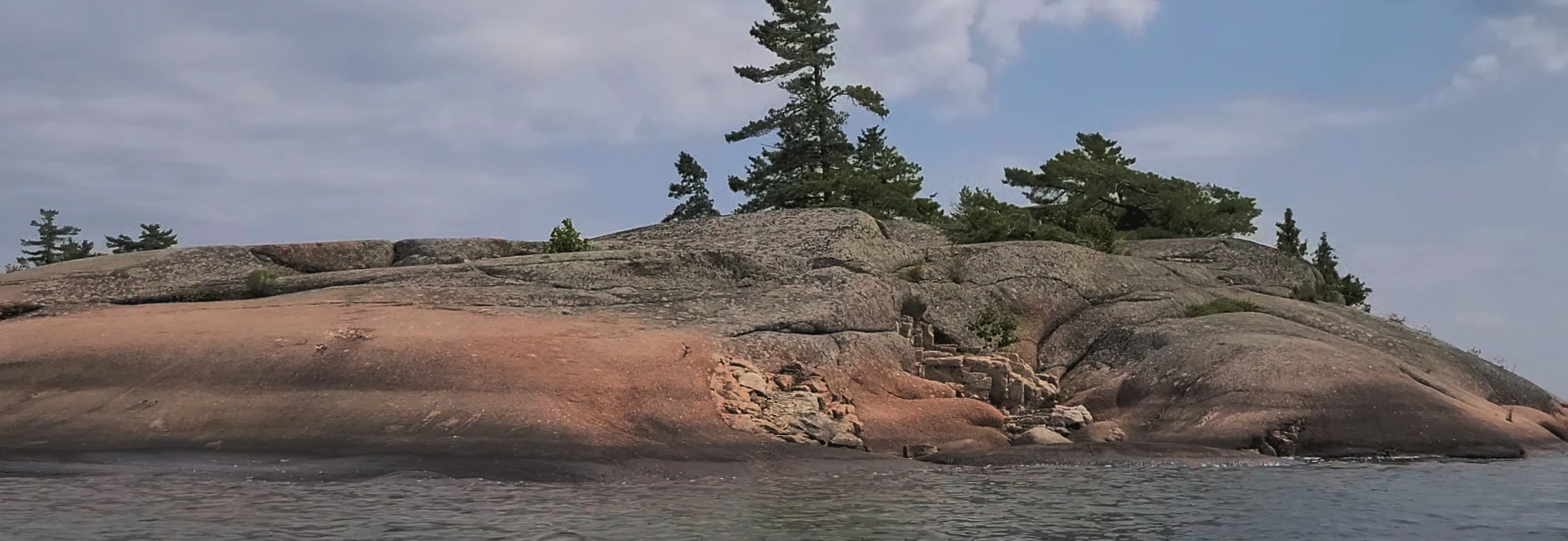
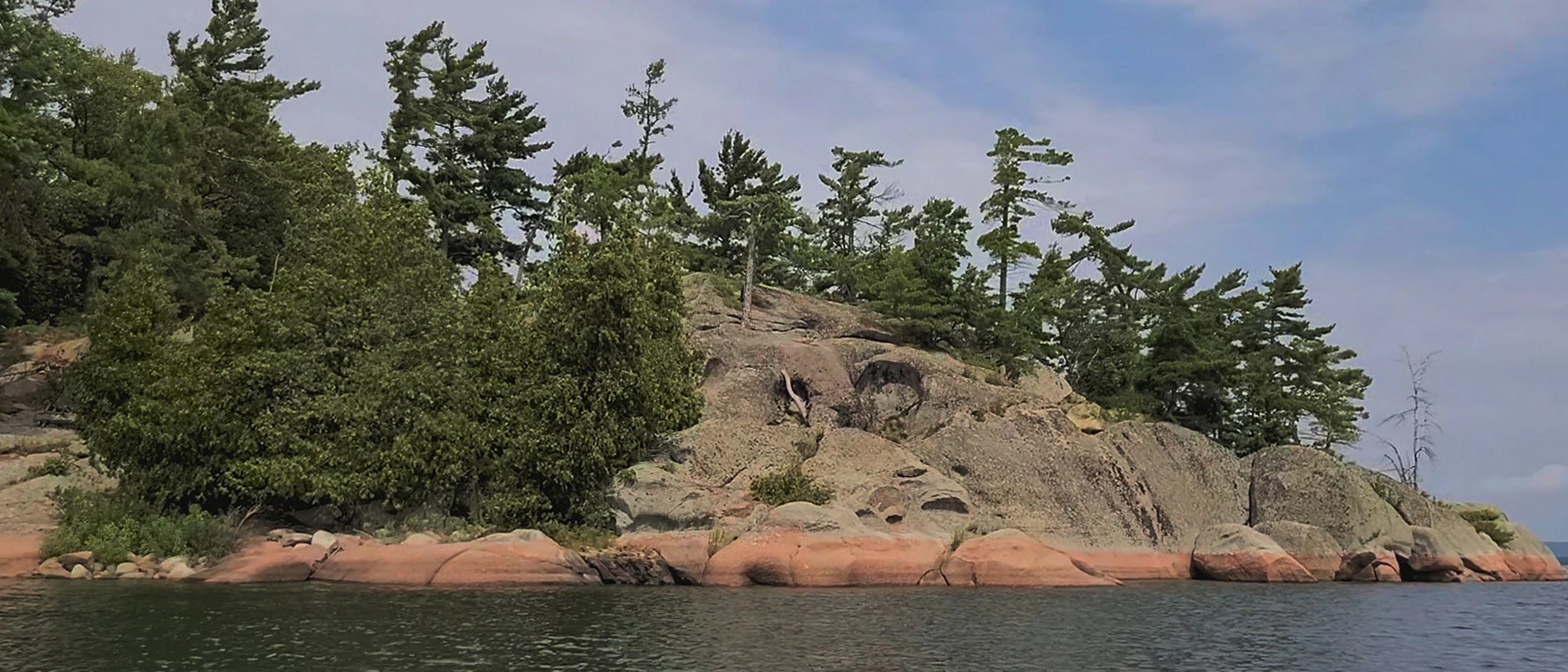
One small rocky island stood alone ahead of me. Its smooth granite looked completely different from everything I had passed that afternoon. A small patch of stunted pine trees bent dramatically in the wind, their branches permanently sculpted by countless storms crossing the North Channel. For a brief moment it offered a little shelter, a welcomed pause before the final push. Even today I can still remember the sound of the wind rushing through its branches.
Beyond that point the waves became noticeably rougher, enough to demand my complete attention. Every movement required balance, every paddle stroke mattered, and stopping to glance at my GPS coordinates no longer felt like a good idea. I had studied satellite imagery for months. Now I was relying almost entirely on memory. Somewhere ahead was the place I had spent an entire year imagining.
The relief of finally seeing an approching island quickly gave way to a different concern. My shoulders ached. My back was beginning to tighten. The daylight was disappearing faster than I wanted. More importantly, I still had nowhere to spend the night. Every solo trip eventually reaches the same point. The adventure gives way to simple necessities. Find somewhere to land. Find somewhere flat enough for a tent. Find enough trees to hang food safely. Before the dusk arrives with swarms of mosquitoes and the promise of darkness.
I finally spotted a small opening in the shoreline. It wasn't ideal. But it was enough.
The waves pushed from directly behind as I carefully aimed the kayak toward the rocks. It wasn't the kind of landing I had imagined during months of planning. There was no welcoming beach. No gentle shoreline. Just piles of rugged rocks to climb out if everything went well. I steadied the kayak near the shoreline, paused for a second, and looked up.
Nothing could have prepared me for what I saw.
The kayak drifted to a partial hault, rocking gently as the waves rolled under the hull. My body instinctively began the landing routine I had practiced countless times before. Between the waves, I steadied myself with the paddle resting across the deck, leaned forward to peel the spray skirt from the cockpit, and prepared to shift my weight for the careful climb onto the rocks.
None of it required much thought anymore, just concentration and careful patience. Months of paddling had turned the sequence into muscle memory. Every movement was deliberate, familiar, and automatic.
Then everything stopped.
Not because I lost my balance.
Not because of the waves.
Something in front of me demanded every ounce of my attention.
My muscles froze. The practiced routine I'd performed hundreds of times simply ceased to exist. Every instinct that had been focused on landing the kayak was instantly replaced by one overwhelming realization.
I wasn't alone.
Standing less than twenty feet away was a bear.
For a fraction of a second, my mind refused to process what my eyes were seeing. After hours of paddling, rough crossings, sore muscles, and constantly searching for a place to land, this was the last thing I expected to find waiting for me.
Even now, years later, I remember how beautiful he was.
His coat wasn't the shaggy, unkempt fur people often imagine on wild animals. It looked rich, healthy, and almost impossibly well groomed. Every strand caught the evening light. But it wasn't his fur that stayed with me.
It was his face.
I had expected to see an animal.
Instead, I found myself looking into the eyes of an individual.
His expression carried an astonishing amount of character. Strength. Pride. Intelligence. Self reliance. Even a hint of uncertainty. Somehow, he looked every bit as startled to discover me as I was to discover him.
For a brief moment, neither of us knew what the other was going to do.
Yelling felt wrong. I didn't want to startle him, and I certainly didn't want to provoke him. Still sitting inside my kayak, I simply spoke in a calm, firm voice.
"Hey, bear."
The transformation was immediate.
The enormous animal spun and exploded into motion with unbelievable speed. He flowed effortlessly across the granite, covering ground that would have taken me minutes to climb. Halfway up the rocks, he stopped, turned back for one final look, and then disappeared over the ridge as silently as he had appeared.
I remained sitting in my kayak for another minute, hardly breathing.
The wind was still blowing. The waves were still crashing behind me.
But for those few seconds, everything else had disappeared.
Eventually, reality returned.
I still needed somewhere to sleep.
The hardest part of the journey was finally behind me.
With camp established on the western shoreline of North Benjamin Island, the urgency that had driven every decision throughout the afternoon slowly disappeared. The kayak was unloaded one hatch at a time, blue Ikea bags found their place around camp, and my attention shifted from reaching the island to simply living on it.
Dinner came first. A dehydrated backpacker's meal that somehow tasted far better than it deserved after a full day of paddling. Next I filtered enough water for the evening and the following morning.
Before darkness settled in, I secured my food as high as possible on a tree well away from camp. Seeing a black bear less than an hour earlier made that evening routine feel considerably more important than it had on previous trips.
For the first time all day, there was nowhere else I needed to be.
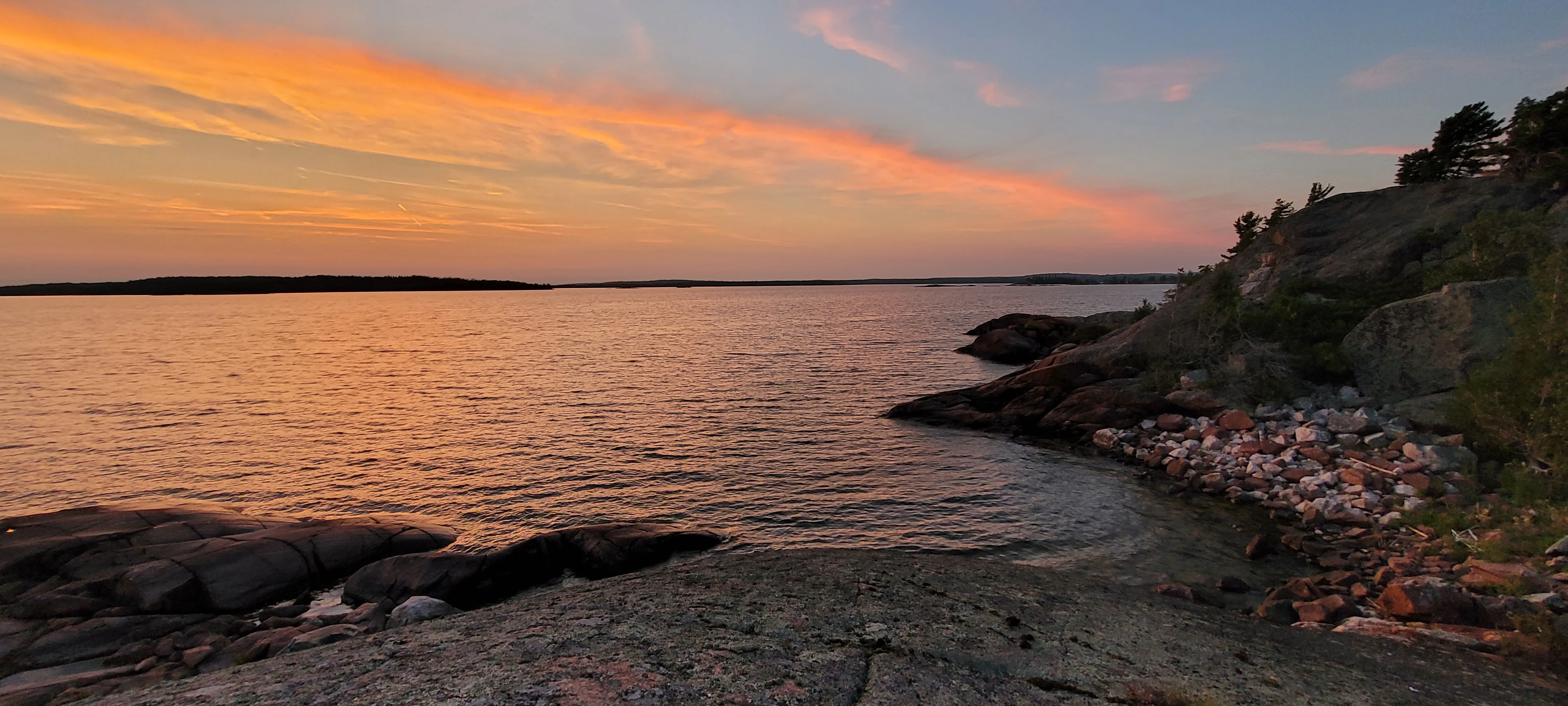
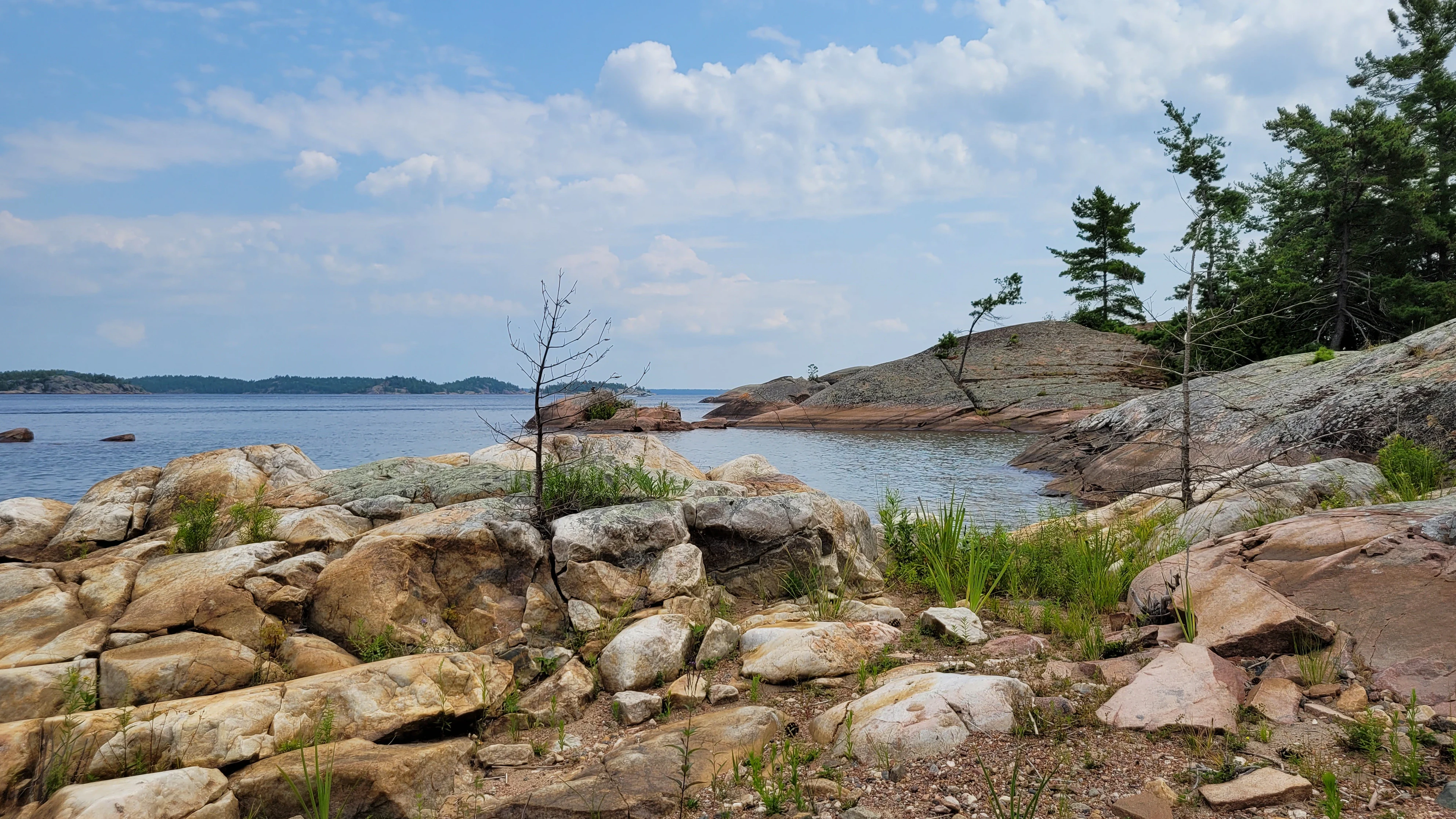
With dinner finished, I wandered only a short distance from camp. The surrounding landscape immediately rewarded that curiosity. The rocks glowed with warm evening light, the North Channel became almost perfectly calm, and every direction seemed to reveal another impossible combination of granite, quartzite, wind-shaped pines and crystal-clear water.
It was only then that I truly realized I had arrived.
Dinner was finished, camp was organized, and for the first time since arriving I had nothing left to do except sit quietly and watch the day come to an end.
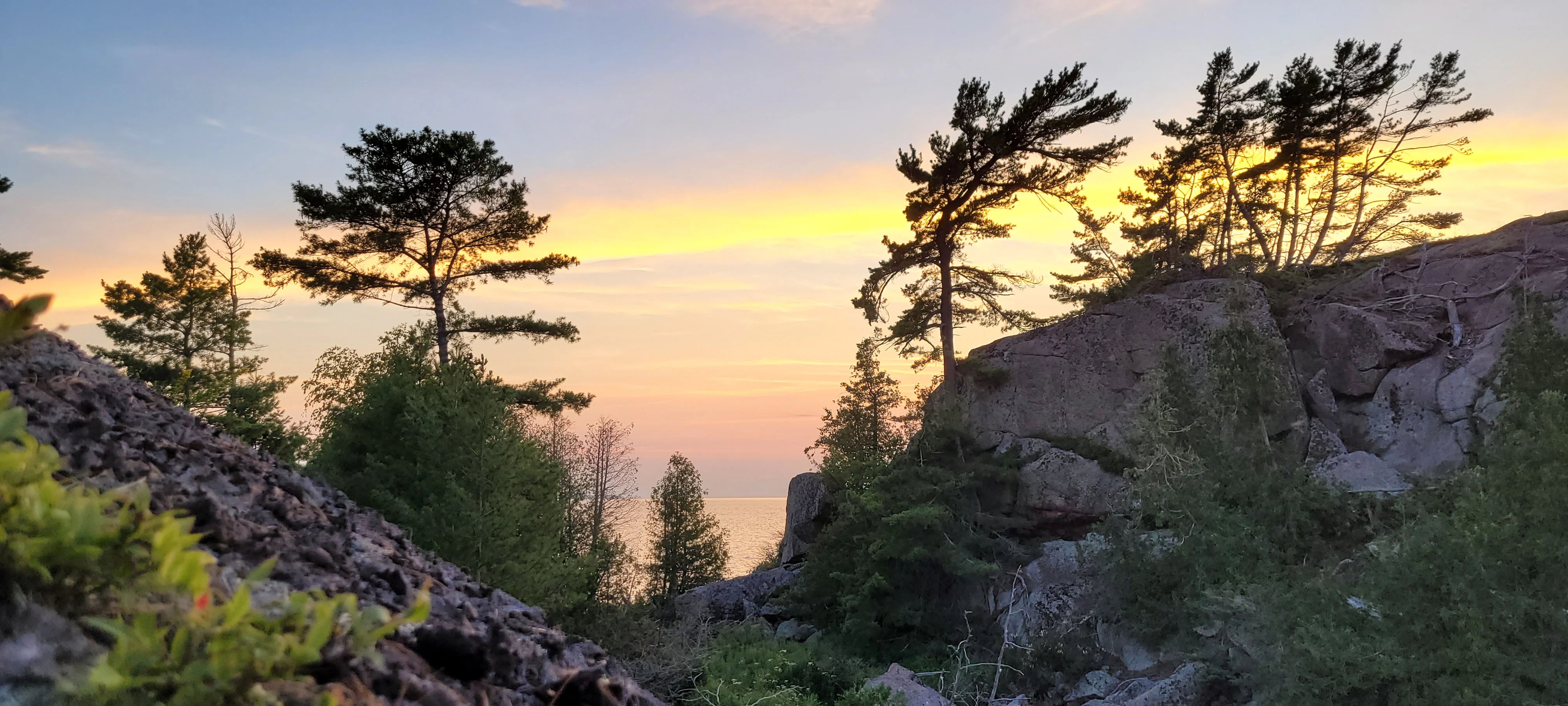
It wasn't the most dramatic sunset I've ever witnessed, but it remains one of the most memorable. The sky was remarkably clear except for a handful of long, impossibly thin clouds stretching across the horizon. As the sun descended, those clouds seemed to ignite independently of the rest of the sky. While the horizon slowly shifted through familiar blues, oranges and reds, the clouds themselves glowed with a rich golden light, suspended above the North Channel like illuminated brush strokes.
Some sunsets don't overwhelm you.
They simply ask you to sit still a little longer.
August 8, 2023
Morning arrived quietly.
For the first time since launching from Spanish Marina, there was nowhere I needed to be. No crossing waiting. No weather to race. No miles left to cover before darkness. The journey that had consumed my thoughts for months was suddenly behind me.
I slept longer than usual, stretched aching shoulders and a sore back, wandered across the granite with my camera, and allowed myself to simply exist in the landscape.
It felt less like discovering an island... and more like the island had decided to reveal herself.
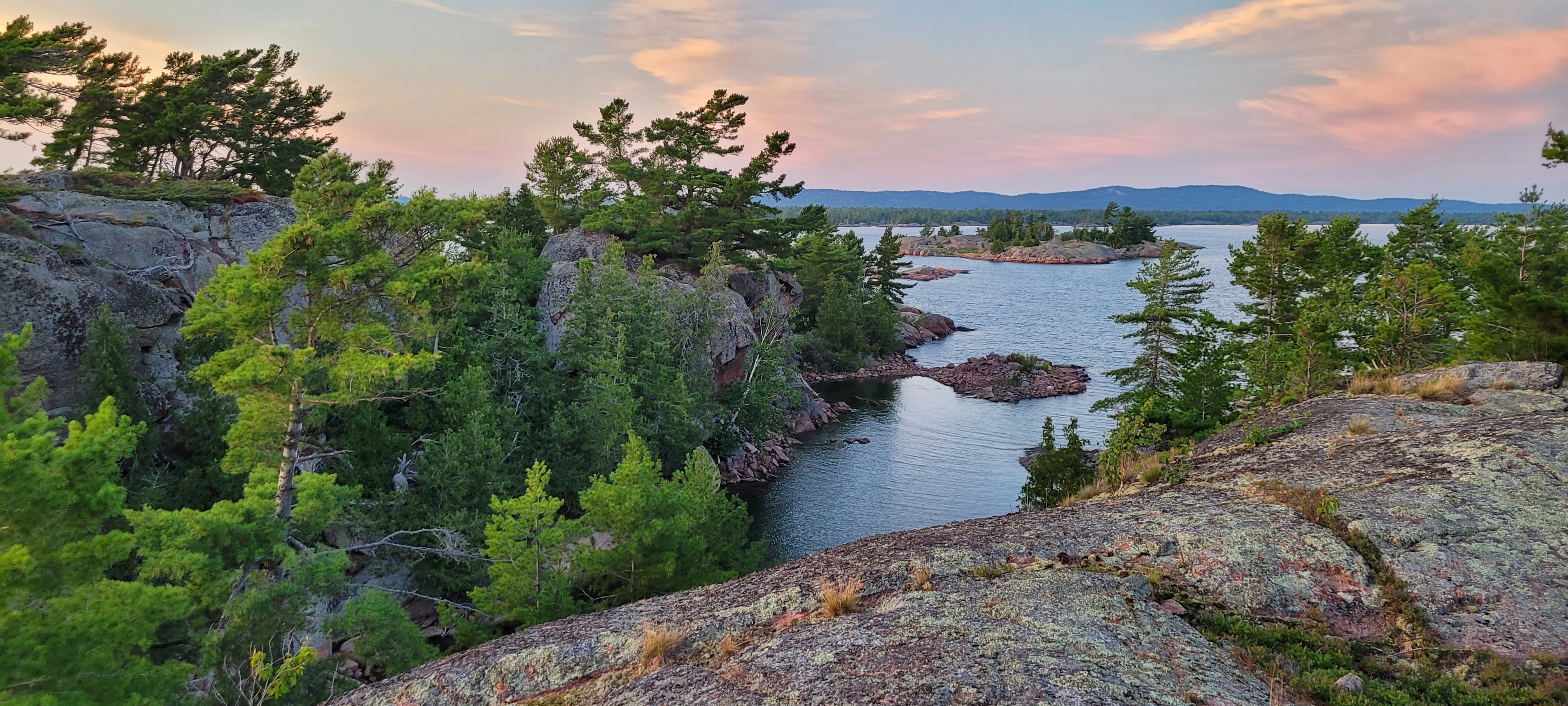
Near the northern tip of North Benjamin Island I climbed onto a granite ridge overlooking the route I had paddled the previous afternoon. From two or three stories above the shoreline, the North Channel stretched toward the horizon while scattered islands faded into layers of blue.
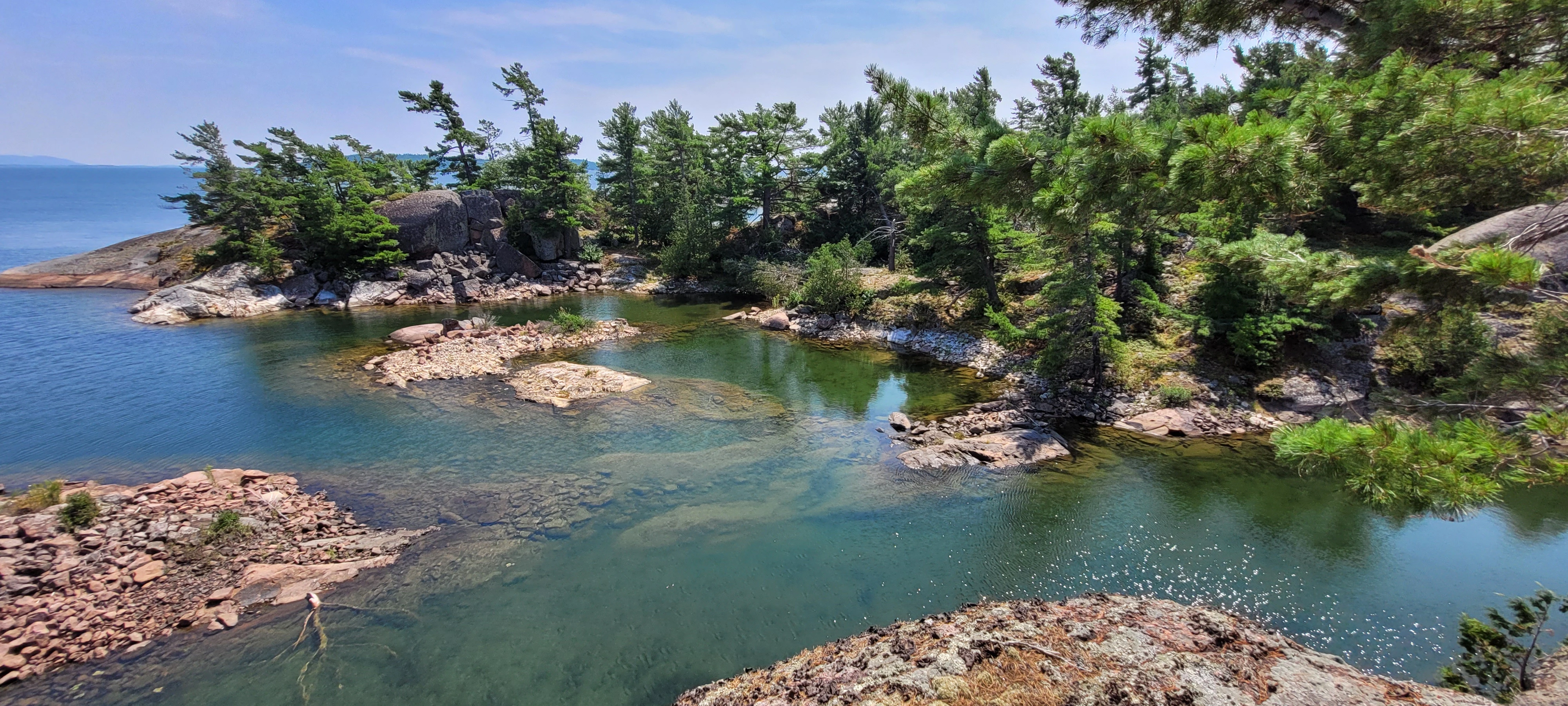
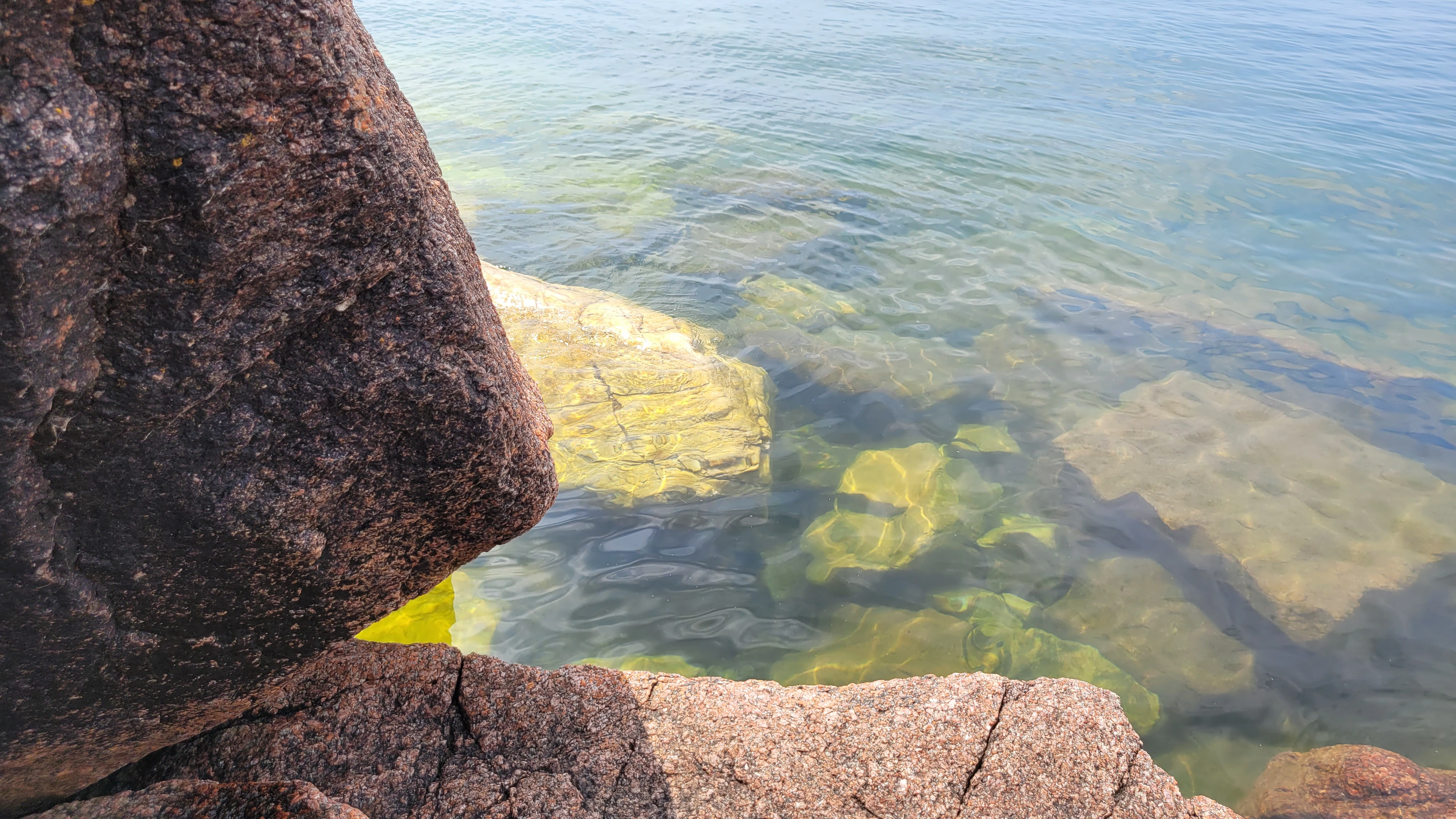
Behind me, a sheltered cove lay perfectly still. The water was so transparent it barely seemed to exist at all. Every submerged boulder remained visible beneath the surface, glowing beneath shades of emerald, turquoise and sapphire that shifted with every passing cloud.
Everywhere I looked there were textures demanding attention. Coarse crystalline surfaces sat beside polished stone worn smooth by thousands of years of waves. Deep cracks framed delicate mosses. Soft, lush, white pines somehow found enough soil to survive where none appeared to exist.
Photography became strangely frustrating. Every composition meant leaving something equally beautiful outside the frame. A photograph could preserve a moment, but never the feeling of standing there surrounded by impossible colours in every direction.
Standing there, I could finally see the journey that had occupied so much of my attention the day before. Fox Island was no longer an uncertain destination, it had quietly become part of the landscape behind me. Beyond it, against the horizon, stood the iconic La Cloche Mountains.
I had paddled the Georgian Bay and thought I understood pink granite. I didn't.
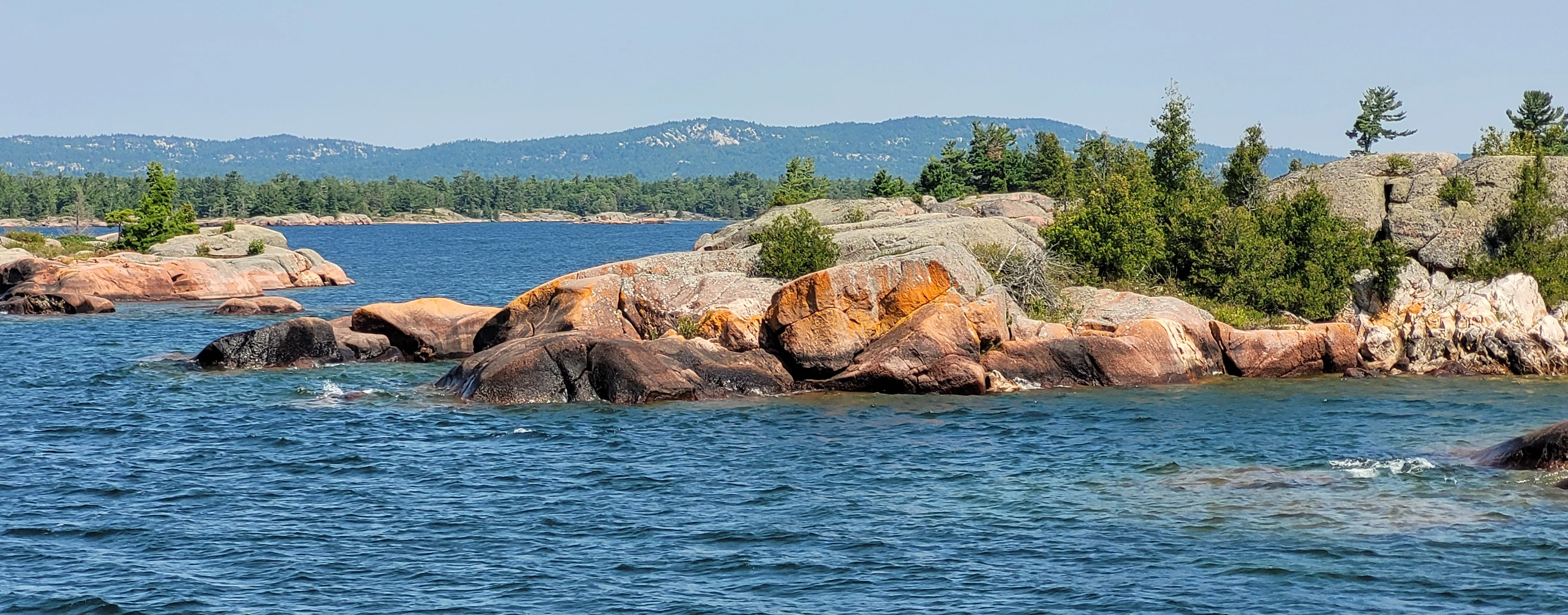
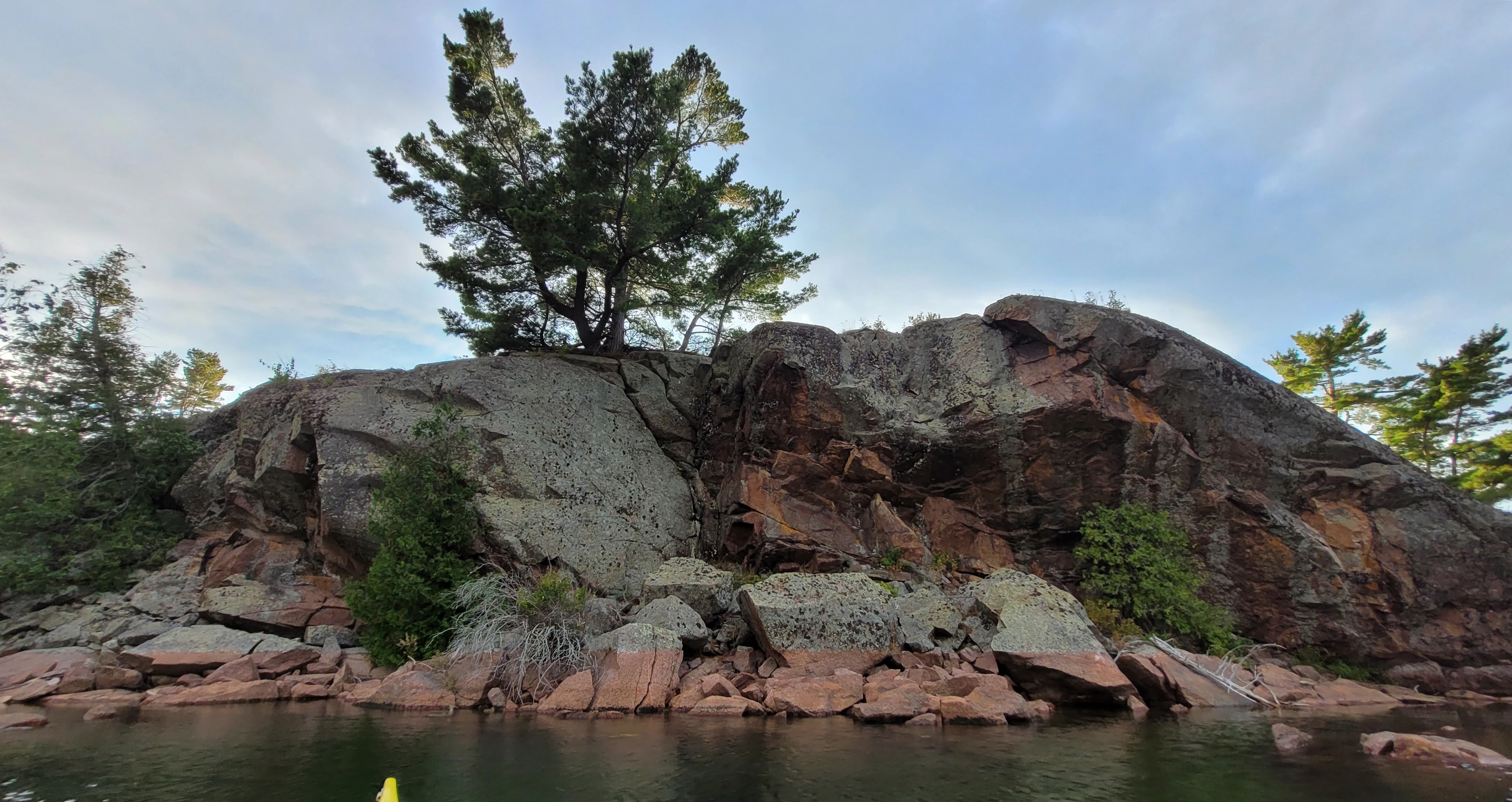
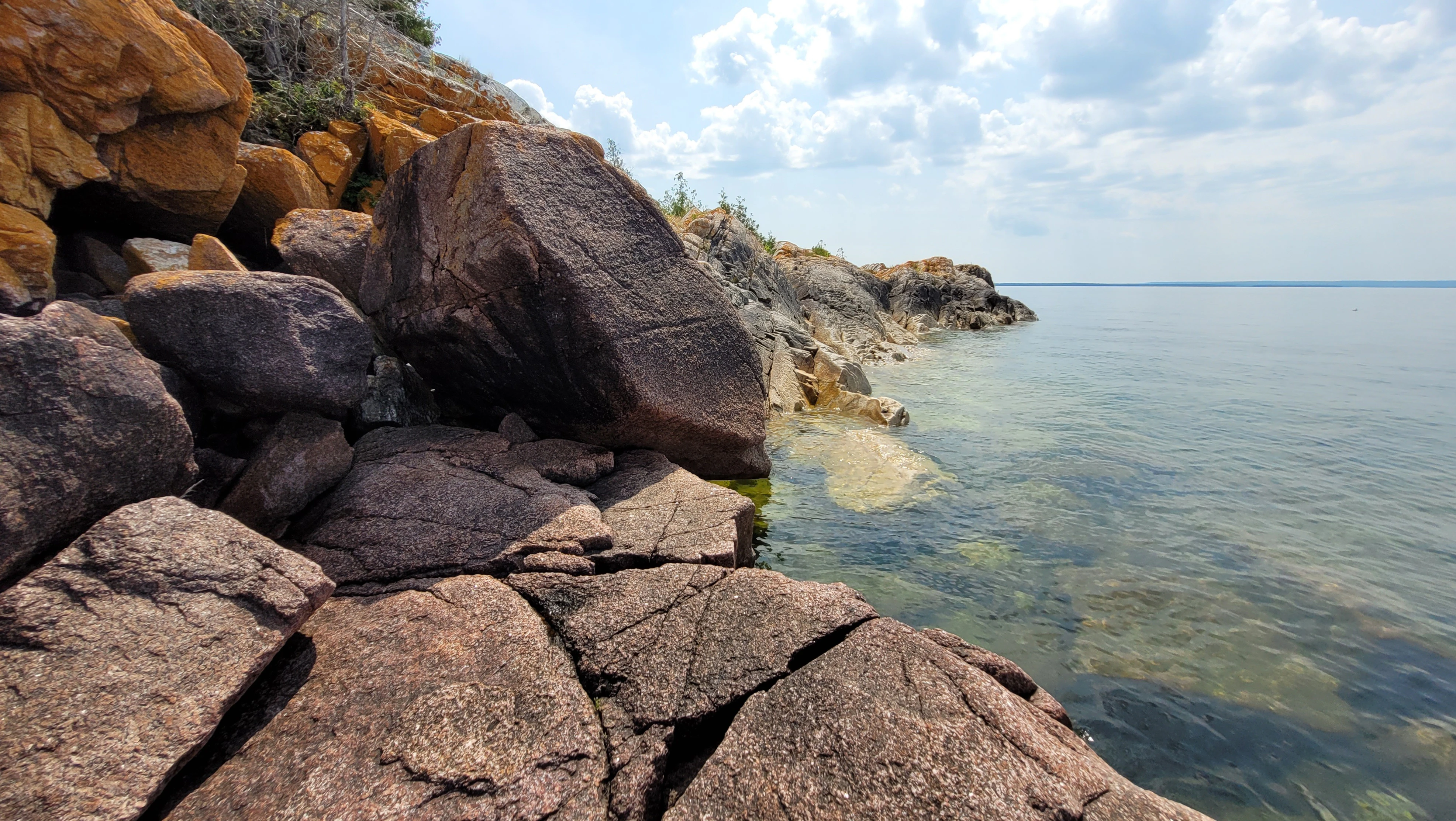
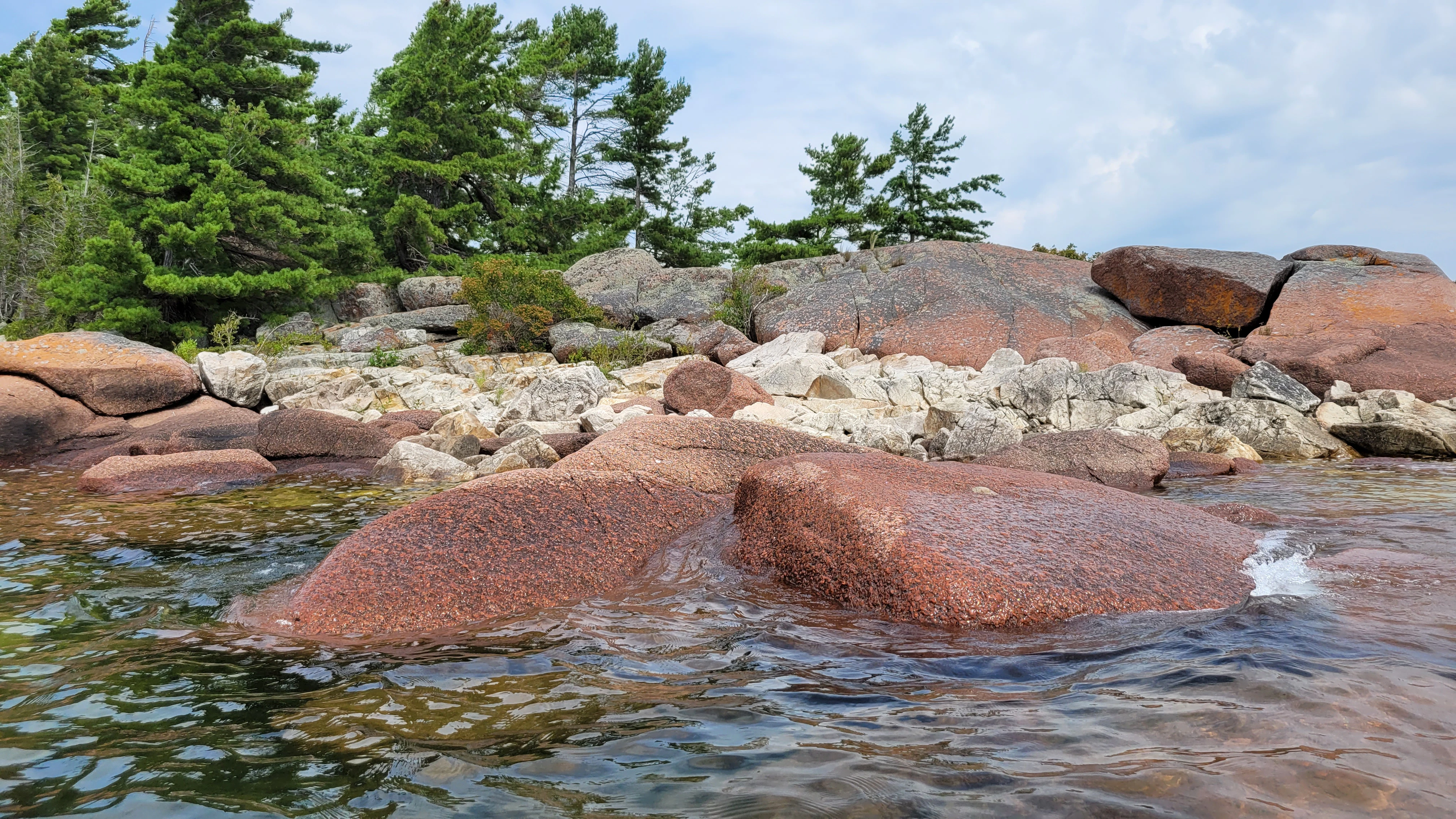
Here the rock seemed alive. Rounded granite flowed into brilliant white quartzite so naturally that the boundary between the two looked impossible. Rich reds blended into pale greys. Brick colours became soft pinks. Bright whites sparkled against dark mineral bands as though someone had painted the landscape rather than geology creating it over unimaginable spans of time.
Morning transformed everything.
The rocks that had appeared brick red beneath the fading evening light now glowed with shades of pink I didn't know existed. Rounded granite rose from the shoreline like enormous polished sculptures while smaller piles of contrasting rock added unexpected bursts of colour throughout the landscape.
Every few steps another view made me stop.
For the first time on the trip, I stopped thinking about where I was going...
...and started appreciating exactly where I was.
After coming this far, it was time to see what else was waiting to be discovered.
The wind hadn't disappeared. Waves were still crashing into the shoreline, one after another. Not big enough to keep me land bound, but powerful and fast. Entering my narrow boat would require some precision and balance.
Leaving camp turned out to be almost as difficult as reaching it.
Unlike a sandy beach or gently sloping shoreline, my launch site consisted of a chaotic, pile of stones. Potentially slippery. They werent heavy enough that they were guaranteed not to roll, but heavy enough that they could severly crush toes, feet or ankles. They weren't jagged, but were far from being round and smooth. After carrying and gently laying down the nose of my kayak into the lake, I walked along side it, holding her straight. I waited for the perfect moment, to get my first leg in, paddle out of the surf, then finally tuck in my second leg.
I waited.
One wave.
Then another.
The kayak lifted.
Settled.
Lifted again.
This time I committed.
For the first few seconds everything worked perfectly.
Relief lasted only a few seconds.
I had managed to settle into the cockpit and push clear of the rocks, but there was still one important step left. My spray skirt was hanging loosely around my waist, waiting to be secured over the cockpit before the next wave arrived.
The next wave arrived first.
Cold water crashed across the deck and poured directly into the cockpit.
My timing had been just a second too slow.
Fortunately I was still close to shore, but "close" did not necessarily mean "safe." Landing again on those same slippery rocks would have been just as awkward as launching from them, and every wave continued trying to turn the kayak broadside against the shoreline.
Turning back wasn't really an option anymore.
Instead, I committed to reaching calmer water.
A small boulder lay only a short distance away. It wasn't far, but getting there required keeping the kayak pointed directly into the incoming waves while paddling with a cockpit that now held several litres of water sloshing beneath me.
Once I finally reached protection from the swell, another challenge began.
Kayaking teaches you very quickly that you only have two hands, no matter how many jobs need doing.
One hand steadied the paddle to brace the kayak. Every few seconds I adjusted the bow to keep it pointed into the remaining waves. Then came the slow process of soaking up the water with the large absorbent ragss I carried specifically for moments like this, wringing them out over the side, and repeating the process over and over until the cockpit was finally dry again.
Only then could I secure the spray skirt properly.
I took a deep breath, looked toward the edge of the bay, and pushed away from the shoreline for the second time that afternoon.
"The Great Lakes have a way
of reminding you
who is really in control."
The bow slipped cleanly through the surf, the rocks began to drift behind me, and the kayak finally felt alive again. Every stroke carried me farther from camp and closer to the sheltered eastern side of the island.
5:30 PM
What had looked intimidating from shore slowly transformed into something entirely different. The farther I rounded the northern tip of North Benjamin Island, the more the wind seemed to surrender. The crashing waves softened, and the North Channel revealed an entirely different personality.
It was as though someone had drawn an invisible line around the island.
One side belonged to the wind.
The other side to the East belonged to silence.
Everything became quieter. Not simply quieter in sound... Quieter in thought.
Only minutes earlier I had been wrestling waves, balancing on slippery rocks and wondering whether launching had been a mistake. Now I found myself gliding through water so calm that every paddle stroke seemed almost intrusive. For the first time since arriving, I stopped thinking about the journey. I simply looked.
Beyond the northern tip of North Benjamin Island, everything changed.
The crashing waves faded behind me, replaced by water so calm it reflected every colour surrounding it. The eastern shoreline unfolded like a gallery of impossible landscapes. I had spent months studying satellite imagery, measuring distances, and imagining what these islands might look like.
Reality was far more extraordinary than anything I had imagined.
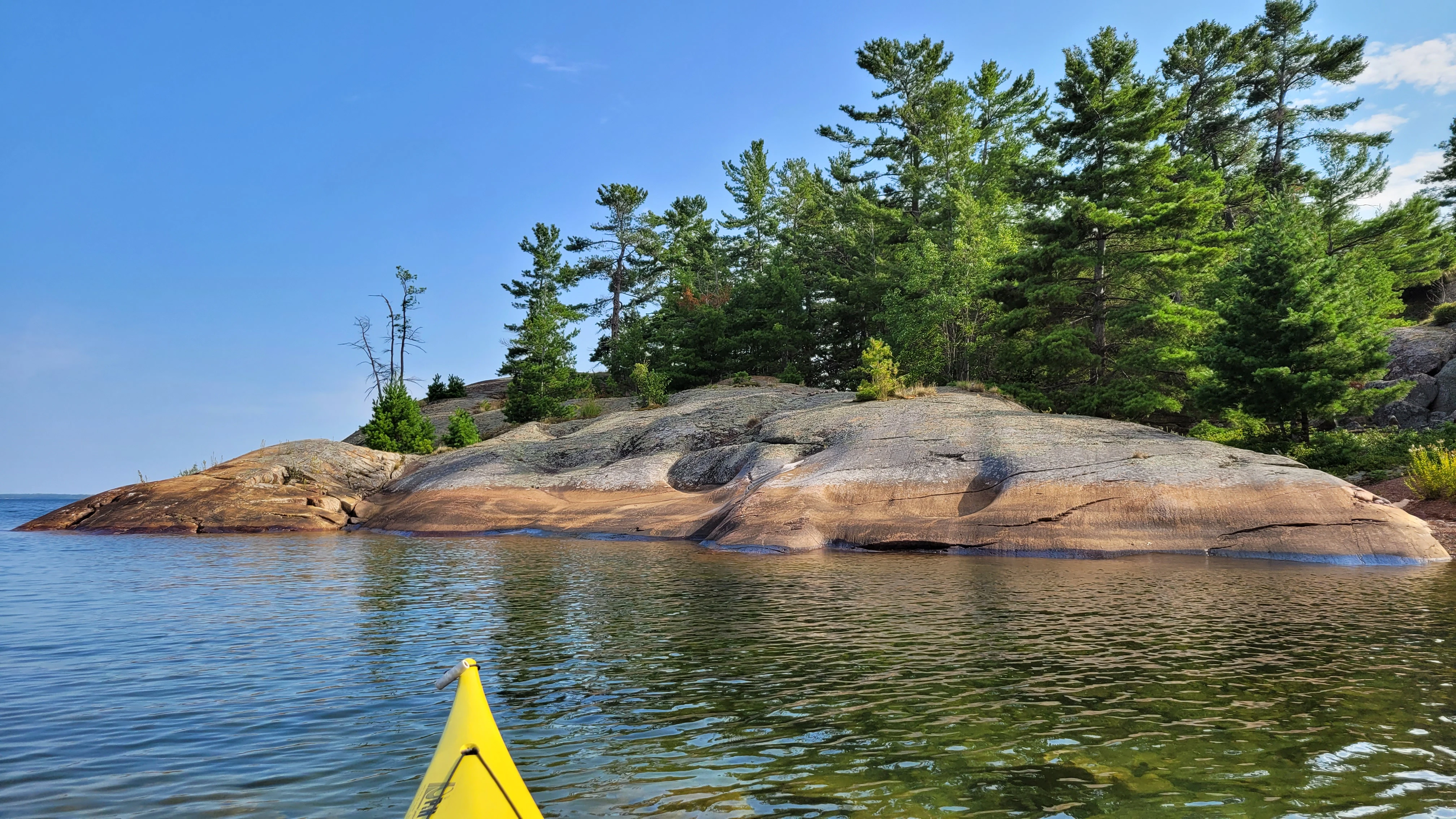
Smooth granite flowed effortlessly into brilliant white quartzite. The rocks shifted from delicate pinks to deep reds, soft greys and sparkling whites. Between them grew windswept pines that seemed too perfectly placed to have grown naturally. Every tree appeared sculpted. Every cliff looked deliberately designed.
It became difficult to believe I was looking at geology at all. The landscape gave the impression that someone had sculpted enormous formations from clay, allowed them to harden, and then carefully painted every surface with a palette of impossible colours.
By the time I reached the eastern side of North Benjamin Island, I realized for the first time since launching that morning that I wasn't completely alone. Sailboats and yachts rested peacefully between the two Benjamin Islands, tucked inside what I would later learn was the main harbour. After hours of wilderness and rough crossings, it was strangely comforting to see other people sharing this remarkable place.
Not long afterward I reached something I hadn't seen since leaving Spanish Marina:
A sandy beach.
It was the first effortless landing of the trip.
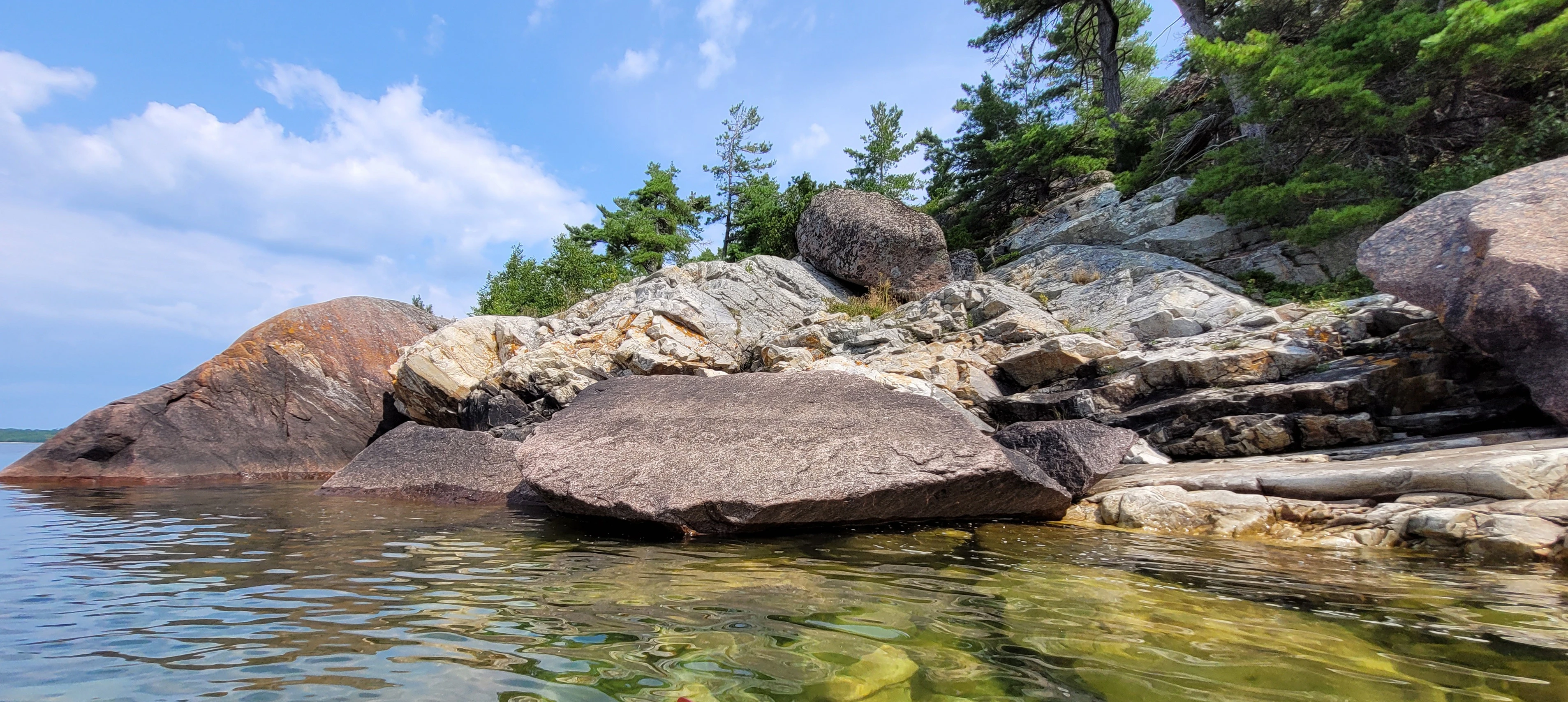
Coarse sand met crystal-clear water. Large white boulders rested beneath the surface while polished quartzite glowed brilliantly in the afternoon sun. Behind the beach stood dramatic cliffs crowned with iconic windswept white pines, while countless islands stretched across the horizon inviting further exploration.
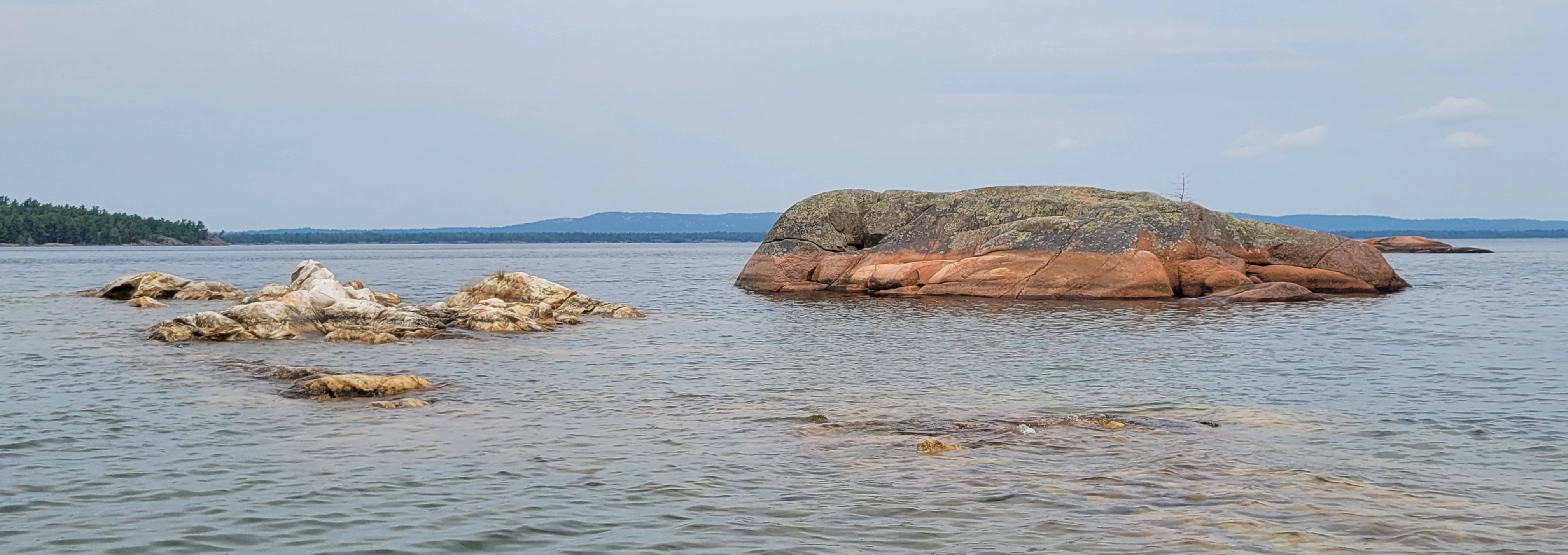
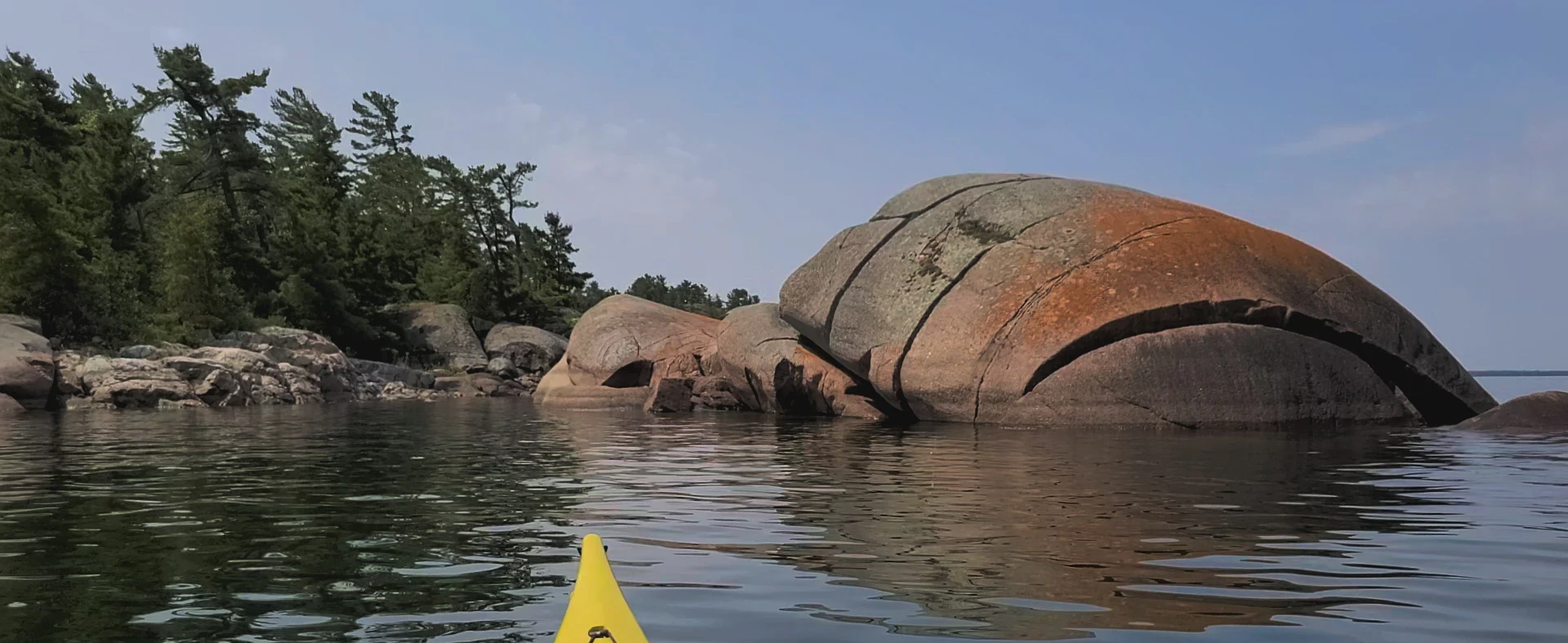
Two boulders caught my attention immediately. One was perfectly rounded, smooth and coloured a rich reddish-pink. Beside it stood another almost pyramid-shaped, brilliant white against the darker shoreline. They looked less like neighbouring rocks and more like two completely different worlds placed side by side.
As I slowly paddled back toward camp, the wildlife reminded me that I was only a visitor here.
Suddenly, behind my kayak, I noticed two beavers swimming directly toward me.
Every previous encounter I had experienced with beavers ended the same way: they saw me, became agitated by precense, and slapped their tails while diving. These two behaved completely differently. Curious rather than frightened, they continued approaching until I finally turned sideways to watch them.
One of them was enormous.
I had never seen a beaver anywhere near that size. I suddenly understood how an animal like this could bring down mature trees. They glided within feet of my kayak, before making a sharp turn and raising themselves above the surface to reveal their size. Moments later they aggresively slapped their tails against the surface before returning back to the shore.
Continuing toward the northern tip of the island, I drifted into a sheltered cove. The water reflected every shade of the surrounding cliffs. Rich pink granite blended into brilliant shades, coarse textures gave way to polished stone, while lichen and moss painted the shoreline with every imaginable shade of green, gold and orange.
Hidden within the cove sat a large beaver lodge.
While photographing it, two more beavers emerged and began swimming home. One immediately stood out. He wasn't the picture-perfect beaver from a nature documentary. His face was rough, weathered and full of character. If he had been a person, he would have looked like someone who had spent a lifetime surviving difficult winters and winning difficult fights. He didn't seem as though he had found this remarkable place by luck.
They disappeared beneath the water beside their lodge, leaving only expanding circles on the otherwise perfect surface.
A little farther along, another small drama unfolded. A family of ducks paddled quietly through a sheltered inlet while tiny ducklings darted between the rocks. One suddenly launched nearly a foot into the air to snatch an insect from above the water.
Moments later I noticed movement among the shoreline rocks. A mink was carefully weaving its way toward them.
Before it could get close, one of the parent ducks spotted the danger and charged aggressively toward the predator, sending it scrambling back into the shoreline vegetation.
Nature carried on exactly as it always had, completely indifferent to the lone kayaker quietly drifting through the middle of it all.
By the time I returned to camp, the sun had begun its slow descent toward the horizon.
Golden hour transformed the islands again. Purples emerged within the granite. Ivory moss suddenly glowed fluorescent green. Pine needles and oak leaves seemed illuminated from within. It felt as though the Benjamin Islands were unwilling to reveal all of their beauty at once, instead saving one final surprise for the closing moments of the day.
August 09, 2023
The morning delivered a sky without a cloud overhead and barely a ripple in the water
Before launching, and finally exploring the islands, I checked the latest marine forecast one more time..
The sky didn't hint of anything threatening, but I made sure to keep an eye on it as I paddled southward along the western shoreline to finally see what lay beyond the bay where I set up camp.
Every few dozen metres revealed another breathtaking landscape. It was impossible not to stop.
The cliffs rose two and three storeys above the water, sweeping across the shoreline in graceful curves.
Every sheltered cove invited exploration. Every offshore rock looked like it deserved its own photograph. I found myself paddling only a short distance before another stretch of shoreline demanded my attention. This is was an island that constantly rewarded curiosity.
"Then came the most memorable paddle break of my life."
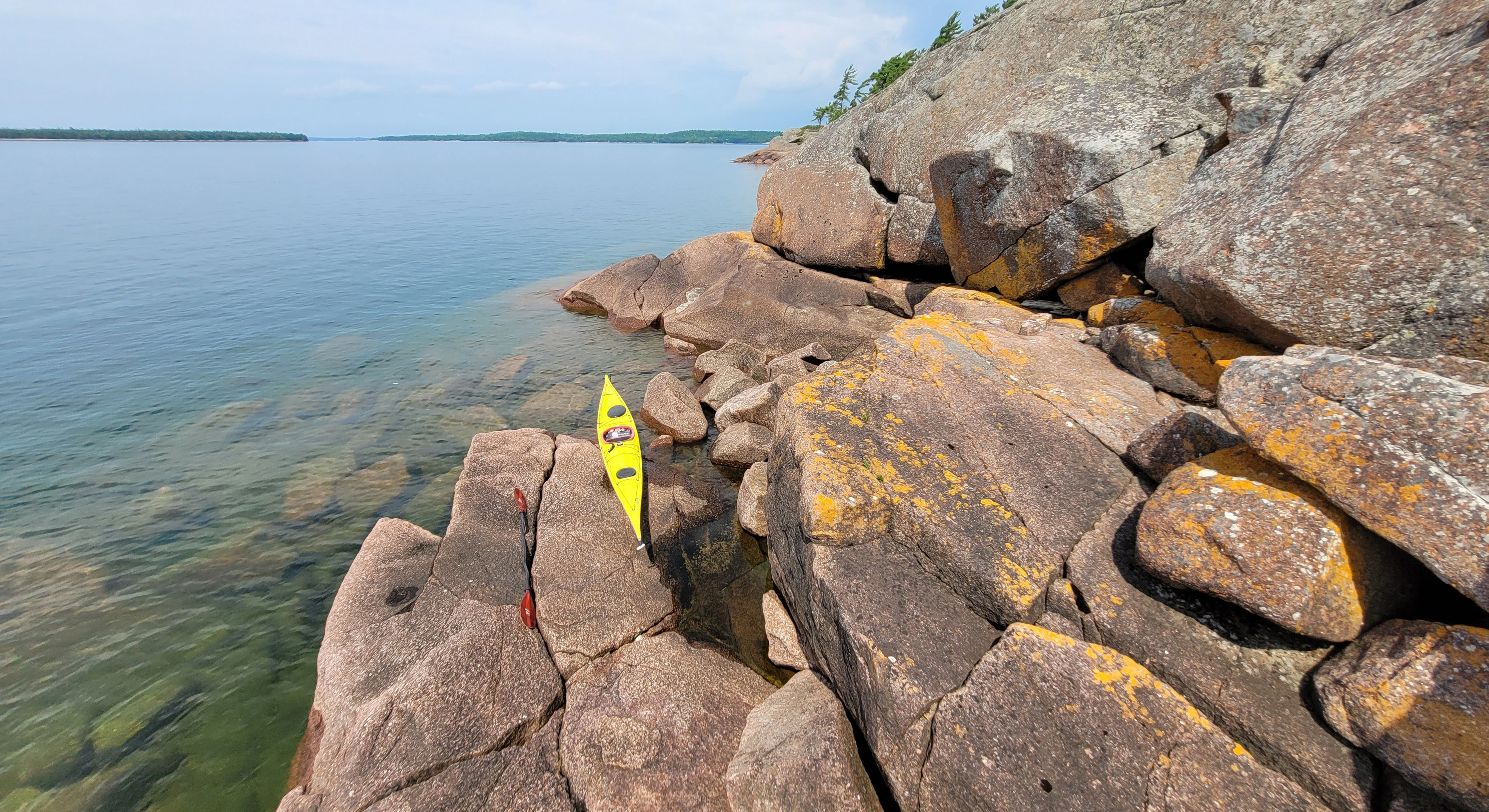
Under almost any other conditions, I would never have considered attempting a landing there. But that afternoon the water lay perfectly still. I eased the kayak alongside the rock, climbed carefully onto the granite, and pulled the boat completely out of the water.
Standing there, surrounded by crystal-clear water, I realized I had accidentally landed in one of the most beautiful places I had ever visited. The white quartzite glowed in the afternoon sun like polished marble. Beneath the surface, enormous boulders rested in water so clear they appeared suspended in air. The colours shifted with every glance—from transparent shallows to neon greens, brilliant turquoise, and finally the deep blue of the North Channel.
I reluctantly climbed back into my kayak, convinced I had just experienced the highlight of the entire expedition. Places like that simply weren't supposed to exist outside of paintings or imagination.
I couldn't have been more wrong.
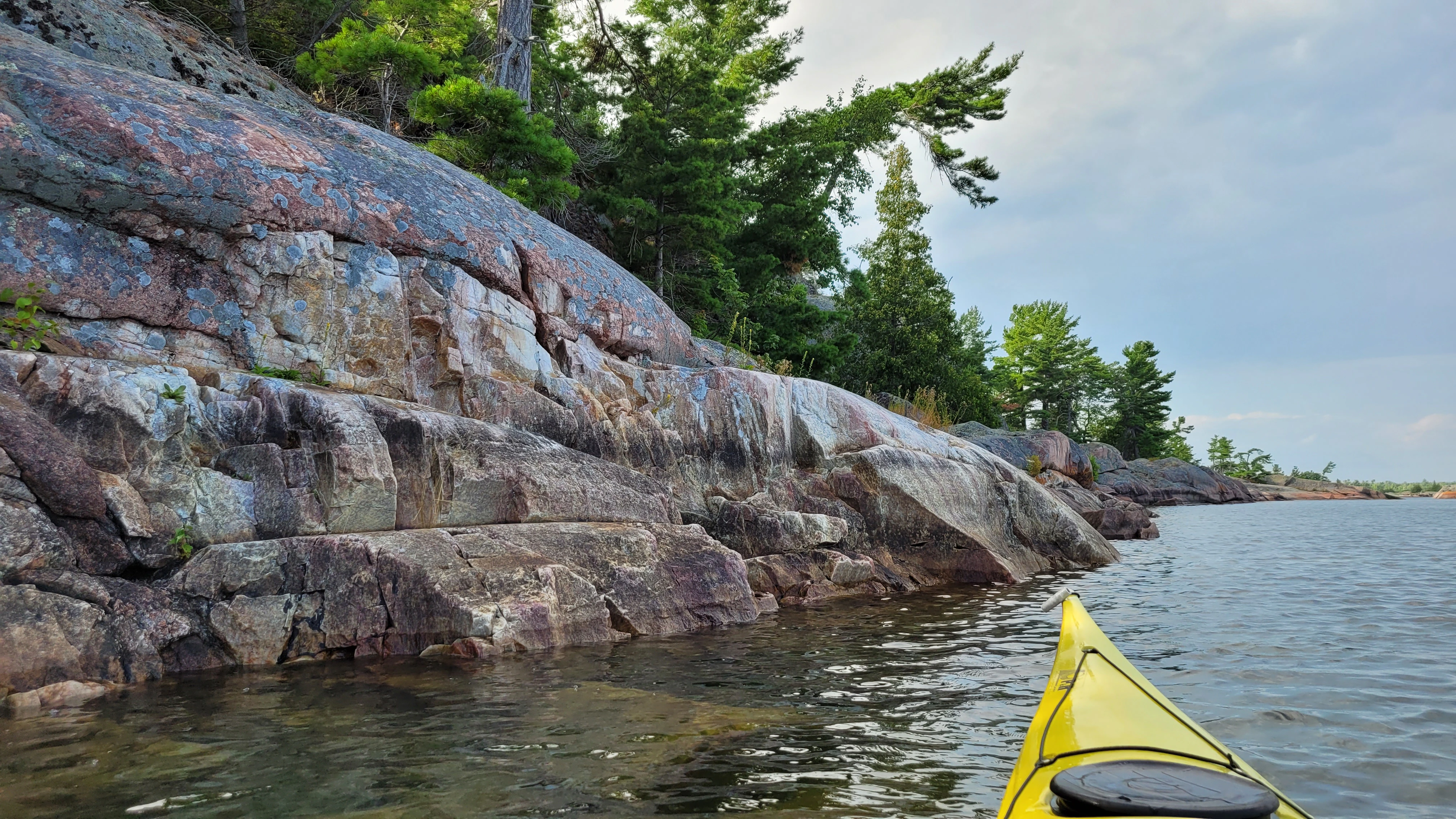
As I rounded the southern tip of South Benjamin Island, the landscape somehow became even more extraordinary. The granite cliffs grew larger, smoother, and more sculptural, rising from the water in enormous sweeping curves. Then, almost without warning, the pink granite would simply end—replaced by dazzling walls of brilliant white quartzite that seemed to glow beneath the afternoon sun.
It wasn't just the contrast of colours that left me speechless. It was the rhythm of the landscape itself. Massive rounded granite. Then a towering white cliff. Then another impossible wall of polished pink stone. Every few hundred metres the shoreline reinvented itself, each bend somehow more spectacular than the last.
Every corner convinced me
I had reached the most beautiful place
on the island.
Every time I was wrong
Reluctantly, I began cutting across a few sheltered bays instead of tracing every metre of coastline. A severe thunderstorm had been forecast for that evening, and I wanted to be back at camp well before sunset. The Benjamin Islands had already given me more than I could have hoped for, and I knew I would need another visit to see everything I had already sailed past.
5:00 PM
Throughout the afternoon I found myself glancing toward the horizon. The forecast still insisted that severe thunderstorms were on their way, but the sky and gentle wind left me unconvinced.
It was easy to believe the forecast had simply gotten it wrong. I had seen extreme weather miss their targets before.
Not long after I returned to camp, the first drops began to fall.
At first it felt almost peaceful. I wandered into the nearby forest where the dense canopy intercepted most of the rain, allowing me to stay completely dry.
The rain eventually intensified enough for me to retreat into my tent.
This was only the second trip with my new tent, and its first real test. At first it performed flawlessly. The rain increased and hammered against the fly while the interior remained perfectly dry. I settled in, quietly impressed with my purchase.
The wind had other plans.
The sounds of the wind, thunder and rain, had me questioning everything I thought I knew about back country camping. The structural support poles of the tent started shifting in towards me. In a moment of panic, I threw my arms up to brace them. I could feel the tremendous force that was pushing them beyond their limit.
Minutes passed that felt far longer than they really were.
It felt like an hour.
Eventually the violence began to ease.
The rain softened. The wind stopped fighting. The thunder distanced itself before dissapearing.
Then, almost as quickly as it had arrived, the storm was gone.
I stepped outside into warm evening air that felt impossibly calm. The wind that had threatened to flatten my campsite now carried only enough of a breeze to keep the mosquitoes away while the sun yielded to another evening.
August 10, 2023
The previous evening's storm had passed, but the forecast still carried another severe thunderstorm warning later that afternoon. I had no interest in testing my luck twice.
It was time to go home.
Breaking camp always carries a different feeling than setting it up. The excitement of arriving has disappeared, replaced by the slow routine of packing every piece of equipment back into its place. Camping gear disappeared into hatches. Tent poles folded into neat bundles. Food bags came down from the trees.
The island that had seemed so unfamiliar only a few days earlier now felt strangely comfortable.
I wasn't quite ready to leave.
Before launching, I walked down to the shoreline one last time to filter fresh water for the drive home.
Reaching down toward the lake, my foot slipped on the smooth granite.
Without warning, I was in the water.
I wasn't hurt. Just wet, surprised, and thoroughly inconvenienced. My carefully packed departure instantly unraveled as I dug dry clothes back out of the kayak.
The Benjamin Islands weren't quite finished humbling me.
"Nature always seems to find one last lesson before saying goodbye."
Eventually everything was packed again, and I pushed away from the shoreline for the final time.
With an ominous sky in the distant north, and smooth waters in front of me. I took a shorter path directly across to Eagle Island. I followed it's perimeter around and crossed to Frechette Island. I made it to the Hagarty Islands in good time. Up until this point, the water was calm. I stopped to evaluate my options.
I had a decision to make.
Continuing west through the shelter of an island chain would eventually force a crossing of nearly two kilometres of open water.
Or...
I could turn north immediately toward the mainland, just over a kilometer away. The crossing would be shorter.
The weather would decide whether that was a good decision.
The wind was returning. Small whitecaps began appearing farther offshore.
With grey clouds approaching in the distance, I took the less risky decision and paddled due north.
Halfway across, the waves intensified significantly. They arrived diagonally across the kayak, constantly challanging my strength and my balance. I lengthened my crossing, deliberately paddling at roughly forty-five degrees to the waves, sacrificing distance for stability. Every correction demanded another paddle stroke. Every paddle stroke demanded more from muscles to propel my loaded boat through the sea.
My shoulders burned.
My lower back tightened.
Then I felt something pinch.
Anyone who has experienced a trapped nerve knows the feeling.
It begins as a tiny warning...and can become complete immobility only moments later.
I had experienced it before. The possibility of that happening alone, far from shore, in rough water was genuinely frightening.
I eased my stroke just enough to avoid aggravating it, found a rhythm that my body could tolerate, and kept moving.
There was only one direction left to paddle.
Forward.
When the mainland finally came within reach, relief quickly gave way to another problem.
I desperately needed to get out of the kayak and stretch, but there were almost no places to land.
The waves continued pushing me sideways while the approaching storm slowly darkened the northern horizon.
Eventually I spotted a small pocket of relative shelter among the Houghton Rocks in Dreamers Bay.
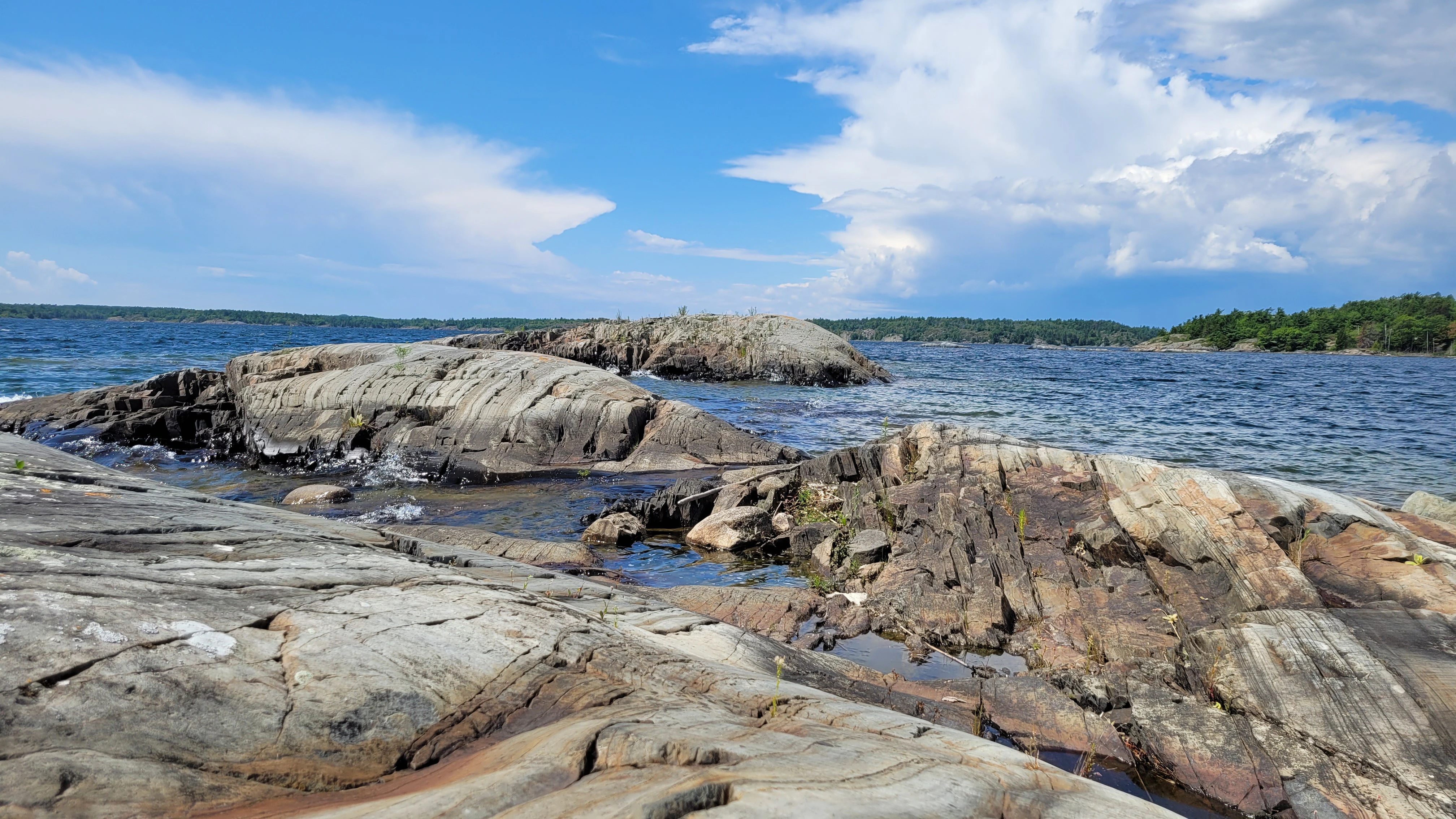
It wasn't an ideal landing. There was just enough shelter and exposed rock to make this work if I executed everything flawlessly.
It was simply the first opportunity I had.
I climbed on top of the unfamilliar stone, with my PFD, laid across the rock like an improvised foam roller, and finally stretched my exhausted back.
Vertebrae cracked.
Muscles relaxed.
For the first time since leaving the islands, I could breathe and think normally again.
As I looked around, I realized this unexpected stop had become another reward disguised as a problem. The Houghton Rocks looked nothing like the Benjamin Islands, or anything else I has seen;
Instead of smooth pink granite and brilliant quartzite, these rocks seemed to flow in sweeping ribbons. Distinct layers curved from one boulder into the next as though an enormous painter had dragged a brush across the landscape before the stone had fully hardened.
Standing there, surrounded by those remarkable patterns, I remember thinking this felt like exactly the sort of place a bald eagle would choose to nest.
Almost on cue...
...a bald eagle silently crossed overhead.
It never acknowledged me.
It simply continued toward the shoreline, disappearing into the approaching sky while I stood there smiling, wondering how many more unbelievable moments this trip still had left to offer.
I slid back into the cockpit, tightened my spray skirt one last time, and pushed away from the shoreline.
The final crossing stretched out ahead across Dreamer's Bay.
Unlike the earlier crossings, the waves were now coming almost directly toward me. It was slower work, but strangely comforting. Meeting each wave head-on felt predictable. Honest. There were no sudden surprises, no awkward side impacts trying to spin the kayak around. Just a steady rhythm of climbing, descending, and moving forward.
One paddle stroke.
Then another.
The wind, however, had other ideas.
It poured straight out of the Spanish River, turning the return into an exhausting grind. Every stroke felt as though I were paddling against a moving conveyor belt, gaining distance only a few feet at a time before the wind tried to reclaim it.
Somewhere behind me, another thunderstorm was building.
I knew that if lightning reached the North Channel before I reached shelter, there would be nowhere left to hide.
The only option was to keep paddling.
Eventually the familiar shoreline began to take shape.
Just before reaching Little Detroit Cut, a powerboat emerged from around the bend. The skipper slowed long enough to warn me that the water inside the Spanish River had become rough and choppy.
I thanked him and smiled. I knew I had already crossed the hardest water of the entire trip.
As I rounded the corner, and continued down the river, the marina slowly appeared ahead, exactly where I had left it three days earlier.
The expedition was over.
Rain began falling softly as I slid onto the dock.
There was no dramatic finish. No cheering crowd. No sense of triumph.
Just quiet satisfaction.
I unloaded the kayak one item at a time, paid for a shower, and let several days of sweat, sunscreen, and exhaustion disappear down the drain.
The facilities felt almost luxurious after living out of a kayak: hot showers, clean washrooms, a sauna, a small fitness room, laundry facilities, and walls covered with maps, fishing photos, and decades of stories from people who had fallen in love with this part of Ontario long before I had.
By evening I was back in Sudbury.
Like I often do after wilderness trips, I wandered into Walmart and rewarded myself with one of their fresh salad kits before checking into a modest motel for the night.
Hanging above the bed was a framed photograph of a lone canoe drifting across a foggy lake.
It felt strangely appropriate.
Three days earlier I had arrived hoping to discover the Benjamin Islands.
Somewhere along the way, I discovered far more than that.
Some journeys end when you reach the shore.
The important ones stay with you long after.
Every expedition eventually comes to an end.
The Benjamin Islands became far more than another destination on a map. They challenged me, humbled me, surprised me, and rewarded every hour of planning that came before them.
Looking back now, I don't remember the distance paddled or how many kilometres separated one point from another. I remember the bear. The impossible colours. The silence after the wind. The beavers. The storm. The feeling of stepping onto rocks that seemed almost too beautiful to be real.
"Some places become memories.
Others quietly become part of who you are."
Thank you for joining me on this journey.